
Quick answer: Turnkey home construction means you brief one company and they deliver a finished, move-in ready home: design, approvals, structure and finishing under one contract. Lock the drawings before work starts, because changes on site cost far more than changes on paper. A professionally managed G+1 house takes 10 to 13 months, according to this guide. Before you sign with any residential construction company Noida has to offer, check the material specifications written into the agreement. Plot owners comparing builders in Noida Extension should ask who holds the approvals and who manages the site.
So You Want to Build Your Own Home in Delhi NCR
Building your own home is not like buying a flat. There’s no brochure to browse, no sample unit to walk through. You’re starting from a plot of land and making hundreds of decisions — some of them irreversible.
Talk to anyone who’s done it in Noida or Gurgaon. They’ll tell you the same thing: the homeowners who came in prepared had a fundamentally different experience from those who figured it out as they went.
This guide is for the prepared ones. We’ll walk you through every step — picking the right plot, locking your design, understanding what actually happens on site, and what things cost in 2026. We’ve also linked out to detailed guides on each topic, so you can go deeper wherever you need to.
What Does Turnkey Construction Actually Mean?
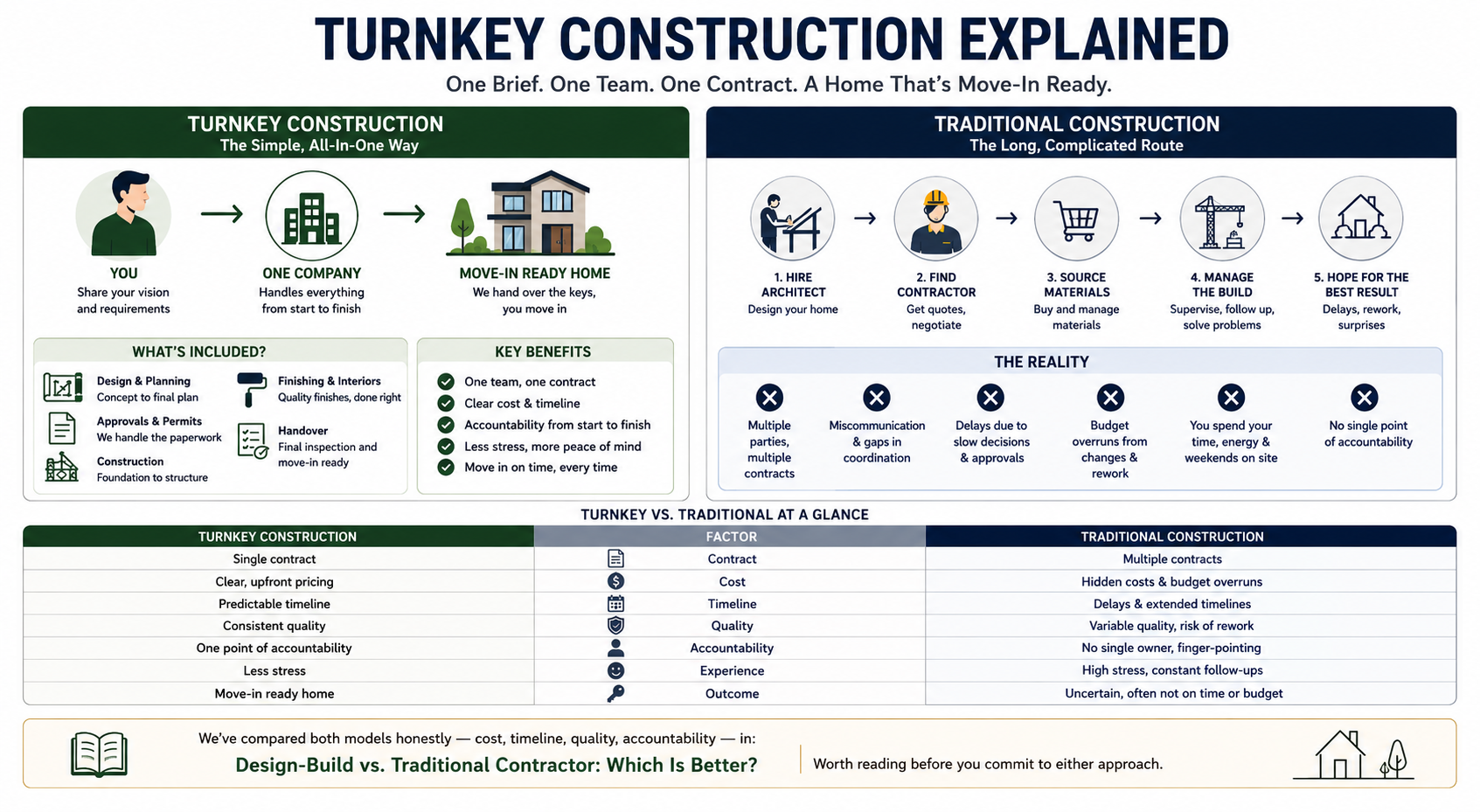
Turnkey means you brief one company, they handle everything, and hand you back a finished, move-in ready home. Design, approvals, structure, finishing — one team, one contract.
The other route is the traditional model. You hire an architect, then separately hunt for a contractor, then manage materials yourself, then spend your weekends on site trying to figure out why the brickwork is three weeks behind. Plenty of people go this route because the contractor quote looks cheaper upfront. Most end up spending more — on rework, on delays, on fixing things that were done wrong the first time.
We’ve compared both models honestly — cost, timeline, quality, accountability — in: Design-Build vs. Traditional Contractor: Which Is Better? Worth reading before you commit to either approach.
How Walls & Dreams Works
Our turnkey construction service runs on a simple principle: one team from brief to handover, no subcontracting, no passing the buck. Your structural engineer and your site foreman are both answerable to the same project manager. Design decisions are locked before construction starts. And you get daily photo updates so you’re never left wondering what’s happening on site.
The full process — what happens when, who’s responsible for what — is laid out here: How It Works at Walls & Dreams.
Step 1: Get the Plot Right
Most people spend more time researching which modular kitchen to buy than the plot they’re building on. That’s backwards.
Your kitchen can be replaced. Your plot cannot be moved. A bad plot choice — wrong zoning, disputed title, waterlogged soil — can derail your entire project before foundation work even begins.
Before signing anything, check these five things at minimum:
- Title documents and encumbrance certificate — clean ownership, no liens or court disputes
- Land use zoning — residential use must be permitted as per the Master Plan
- FAR / FSI — determines how much floor area you’re actually allowed to build
- Soil type and water table depth — directly affects foundation design and cost
- Setback requirements — the buildable footprint after mandatory margins from boundaries
There are actually 12 checks worth running before you buy in Delhi NCR — including things specific to Noida, Greater Noida, and Gurgaon that most buyers miss. All of them are in our Plot Selection Guide: What to Check Before You Buy.
Step 2: Don’t Break Ground Until the Design Is Final
Here’s a number worth remembering: changes made on paper cost ₹1. The same change made on site, after construction has started, costs ₹5 to ₹10.
Say you decide mid-construction that you want to shift the master bathroom. That means breaking already-laid tiles, cutting into concrete, rerouting CPVC pipes, redoing the waterproofing, and re-tiling — all for a change that would’ve taken 10 minutes on the drawing. We’ve seen this add ₹40,000–80,000 to a project for a single room change.
We don’t start construction until the drawings are done and signed off. All of them — architectural, structural, and MEP (plumbing, electrical, air conditioning positions). This is not a formality. It’s the only way to run a predictable project.
Lock these five things before Day 1 on site:
- Floor plan — exact room sizes, door and window positions, staircase layout
- Structural system — almost always RCC frame in Delhi NCR, but needs to be confirmed
- MEP layout — every tap, drain, switch point, and AC sleeve position
- Slab decisions — sunken slab for bathrooms, terrace drainage, false ceiling provisions
- External design — facade, roof type, boundary wall, gate position
Anything left undecided here will create a stop-start rhythm on site. And every stop costs time and money.
Step 3: Know What’s Happening on Site at Every Stage
Construction looks chaotic if you don’t know the sequence. It isn’t. There’s a defined order — you can’t plaster before the brickwork is done, you can’t tile before the waterproofing is tested — and knowing that order is how you catch problems before they get buried.
The main stages, in sequence:
- Site preparation and layout marking
- Foundation — excavation, PCC bed, rebar, concrete pour, curing (minimum 7 days, non-negotiable)
- Plinth construction with damp-proof course layer
- RCC frame — columns, beams, and slabs floor by floor
- Brickwork and external wall panels
- Plumbing and electrical rough-in — all concealed work before plastering
- Plastering — base coat, finish coat, curing between coats
- Waterproofing — bathrooms, terrace, any water features
- Flooring and tiling
- Doors, windows, and grilles
- Paint, fixtures, fittings — the final stretch
- Snag walkthrough and handover
Each stage has its own quality checkpoints — things to verify before the next stage covers it up. We’ve gone through every single one, with realistic durations, in: Stages of House Construction Explained (Step by Step).
The Three Stages Where Things Go Wrong Most Often
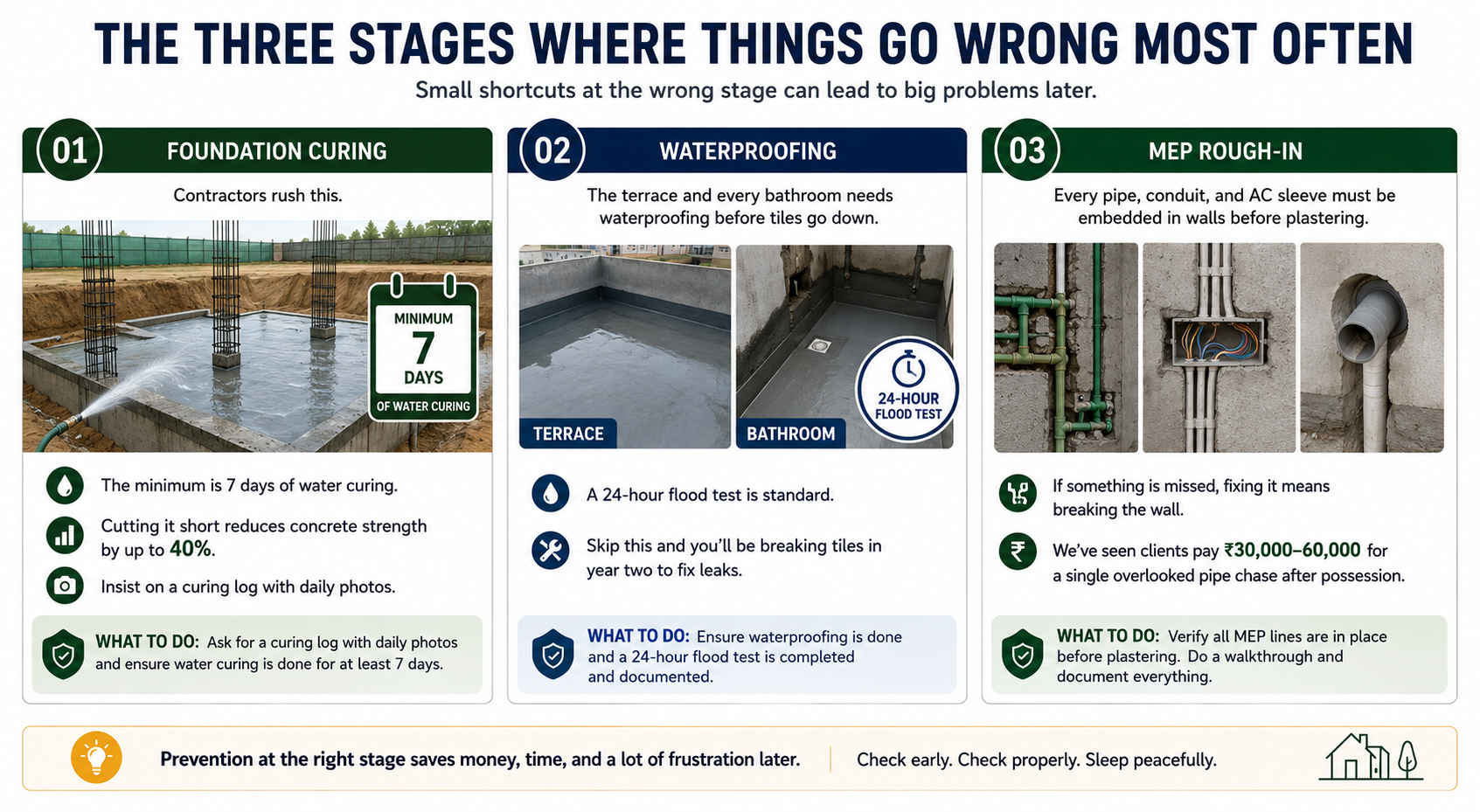
Foundation curing: contractors rush this. The minimum is 7 days of water curing. Cutting it short reduces concrete strength by up to 40%. Insist on a curing log with daily photos.
Waterproofing: the terrace and every bathroom needs waterproofing before tiles go down. A 24-hour flood test is standard. Skip this and you’ll be breaking tiles in year two to fix leaks.
MEP rough-in: every pipe, conduit, and AC sleeve must be embedded in walls before plastering. If something is missed, fixing it means breaking the wall. We’ve seen clients pay ₹30,000–60,000 for a single overlooked pipe chase after possession.
Step 4: Set a Realistic Timeline
Ask any contractor how long it’ll take. They’ll say 12 months. Most self-managed builds in Delhi NCR run 16–20 months. Some drag past two years.
Rough benchmarks for a professionally managed build:
- Single storey (G): 7 to 9 months
- G+1: 10 to 13 months
- G+2: 13 to 18 months
Add 30–50% to those figures if you’re managing it yourself without a dedicated site team.
Five things determine whether your build stays on schedule — design completeness before construction starts, size of the structure, whether you’re using a turnkey team or coordinating multiple vendors, Delhi NCR’s monsoon season (July to September), and pre-construction approval timelines from local authorities.
We’ve broken all five down with a month-by-month breakdown for a G+1 house in Noida: How Long Does It Take to Build a House in India? — including the best and worst times of year to start construction in Delhi NCR. Our 270-day target for a standard G+1 build is achieved by running non-dependent stages in parallel — foundation curing and brickwork procurement happen simultaneously, not sequentially.
Step 5: Know What Things Actually Cost in 2026
The ₹1,500/sq. ft. number you’ll find on most property forums is fiction. It was roughly accurate in 2018. Steel has moved significantly since then. So has sand, labour, and everything else.
Current ground reality in Delhi NCR:
- Basic construction (economy finishes, standard materials): ₹2,000–2,400/sq. ft.
- What most homeowners actually build (standard spec): ₹2,500–3,100/sq. ft.
- Premium — marble, imported fittings, home automation: ₹3,200–3,800/sq. ft.
For a 2,500 sq. ft. G+1 at standard spec, you’re looking at ₹62–78 lakh in construction cost alone. That’s before plot, interior design, modular kitchen, landscaping, and utility connections — which together can add another ₹18–28 lakh.
The other thing most contractor quotes don’t mention: steel and cement prices fluctuate. A 12-month build that starts with steel at ₹62/kg can finish with it at ₹70/kg. Get a price escalation clause in your contract and cap it.
Stage-wise cost breakdowns with current June 2026 material rates are in our detailed guide: How Much Does It Cost to Build a House in Delhi NCR? (2026 Cost Breakdown). For a quick number on your specific plot size and floor plan: try our free cost calculator.
Step 6: Quality Control — What It Actually Looks Like
Most homeowners think quality control means walking the site once a week and pointing out things that look off. By the time something looks off, the problem is usually already set in concrete — literally.
Real quality control happens before each stage is closed, not after. It means checking the rebar spacing before the pour, not after. Testing the waterproofing before tiles go down, not after a monsoon season reveals a leak.
On our sites, this is how it works in practice:
- Rebar inspection before every concrete pour — spacing, cover, and lap length checked against structural drawings
- Concrete cube samples taken at every pour — tested at 7 days and 28 days
- 24-hour flood test on every bathroom and terrace before tiling begins
- Electrical continuity and earthing verified before plastering seals the conduits
- Stage sign-off — you or an independent engineer approves before the next stage starts
Our site engineer is on your project full-time — not splitting attention across three sites like most visiting supervisors. Daily photo reports go to you every evening. If you want to know what happened today on site, you don’t have to call anyone.
Step 7: What Happens After Handover Matters
The first monsoon tells you whether your terrace was waterproofed properly. The first summer tells you whether the electrical load was planned correctly. The first winter — if the insulation is any good.
A contractor who disappears at handover was never incentivised to do any of that well. A builder whose warranty is on the line for 12 months after possession is a different story.
Our WD Care programme covers:
- Post-handover warranty visits at 6, 8, and 12 months
- Free snag rectification within the warranty period
- 24/7 CCTV site access for the client during construction
- Complete handover package — as-built drawings, waterproofing certificates, electrical test reports

Why Homeowners in Delhi NCR Build With Walls & Dreams
Over 1 lakh sq. ft. delivered across Noida, Greater Noida, and Gurgaon. Here’s what we do differently:
- In-house team, no subcontracting — your site engineer works for us, not a labour agent
- BOQ-based transparent pricing — no surprise additions mid-project
- 270-day delivery on G+1 builds — achieved through parallel stage scheduling
- Design and construction under one roof — no architect-contractor blame games
- Post-handover care programme — we’re accountable well past possession day
Read the Full Guides on Each Topic
Each section above links to a deeper guide. Here’s the full list:
- Stages of House Construction Explained (Step by Step) — what happens at each stage, what to verify, and which shortcuts will cost you later
- How Long Does It Take to Build a House in India? — the 5 factors that control your build timeline, with a month-by-month breakdown for G+1 in Delhi NCR
- Design-Build vs. Traditional Contractor: Which Is Better? — honest head-to-head across cost, quality, accountability, and timeline
- Plot Selection Guide: What to Check Before You Buy — 12 checks to run before you sign any plot agreement in Noida, Greater Noida, or Gurgaon
- How Much Does It Cost to Build a House in Delhi NCR? (2026) — current rates, stage-wise cost breakdowns, and 5 ways to avoid overruns
Ready to Start? Let’s Talk.
Share your plot details, your rough floor plan idea, and your budget. We’ll give you an honest assessment — what’s buildable, what it’ll cost, and how long it’ll take. No sales pitch. Talk to our team or run a quick cost estimate to begin.
Frequently asked questions
What does turnkey construction mean?
You brief one company, they handle everything and hand over a finished, move-in ready home. Design, approvals, structure and finishing run under one team and one contract, instead of you hiring and managing each party.
Why should the design be final before construction starts?
Changes made on paper cost far less than the same change made on site, where finished work has to be broken and redone. The guide asks for architectural, structural and MEP drawings to be signed off before Day 1.
How long does it take to build a house in Delhi NCR?
For a professionally managed build, the guide gives 7 to 9 months for a single storey, 10 to 13 months for G+1 and 13 to 18 months for G+2. Add 30-50% if you manage the build yourself without a dedicated site team.
What should I check before buying a plot?
At a minimum: title documents and encumbrance certificate, land use zoning, FAR/FSI, soil type and water table depth, and setback requirements. These decide how much you can build and what the foundation will cost.
How long should foundation concrete be cured?
The guide says the minimum is 7 days of water curing and calls it non-negotiable. It suggests insisting on a curing log with daily photos, since contractors often rush this stage.
Which stages need testing before they are covered up?
Rebar must be inspected before every concrete pour, waterproofing needs a 24-hour flood test before tiling, and electrical continuity and earthing should be checked before plastering seals the conduits.