
The Honest Answer: It Depends on Five Things
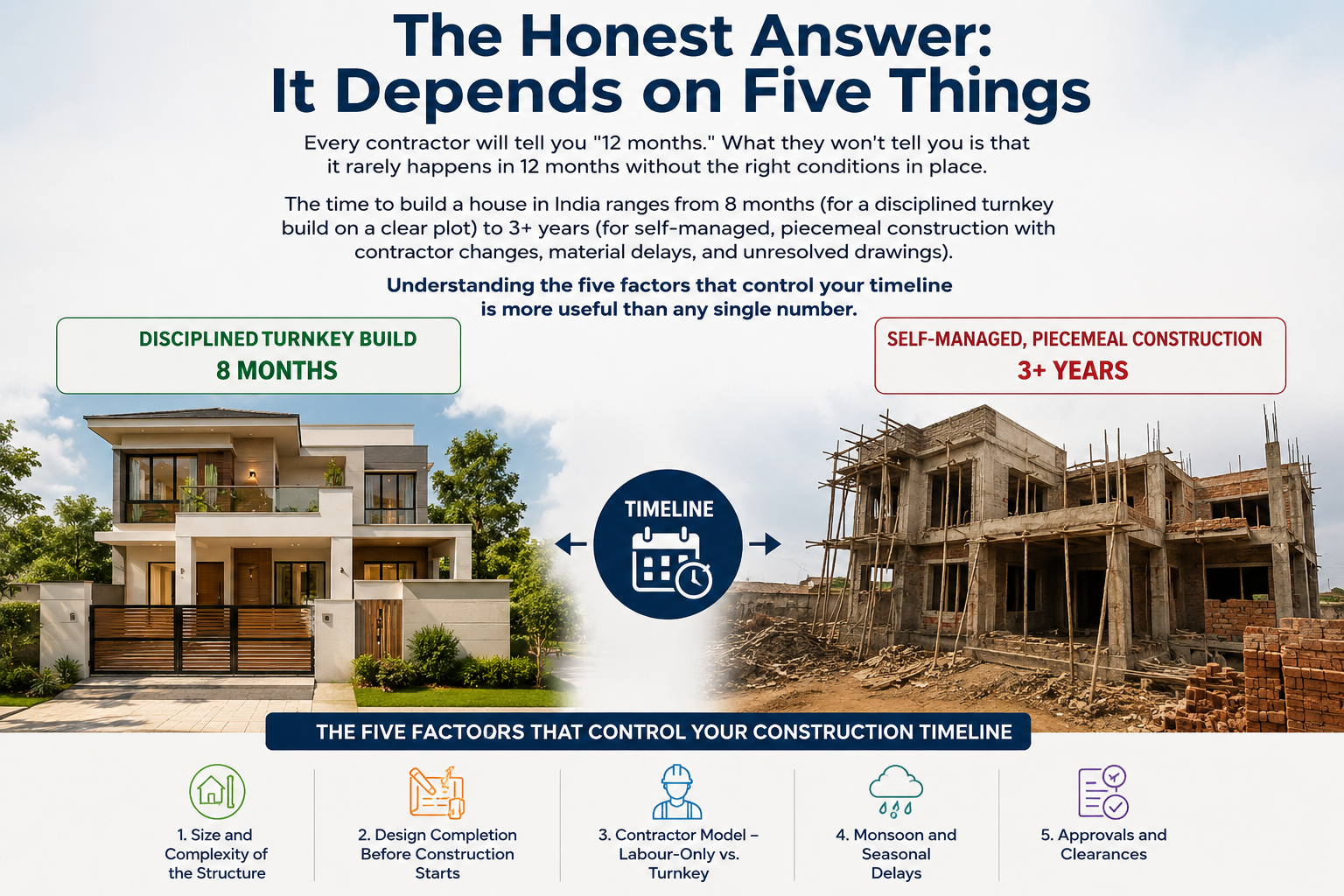
Every contractor will tell you ’12 months.’ What they won’t tell you is that it rarely happens in 12 months without the right conditions in place.
The time to build a house in India ranges from 8 months (for a disciplined turnkey build on a clear plot) to 3+ years (for self-managed, piecemeal construction with contractor changes, material delays, and unresolved drawings). Understanding the five factors that control your timeline is more useful than any single number.
Factor 1: Size and Complexity of the Structure
A G (ground floor only) house on a 100 sq. yd. plot is not the same project as a G+2 bungalow on 300 sq. yd. with a basement, terrace garden, and home automation.
- G (Single storey, up to 1,500 sq. ft.): 7–9 months
- G+1 (Two storey, up to 2,500 sq. ft.): 10–13 months
- G+2 (Three storey, up to 3,500 sq. ft.): 13–18 months
- G+3 with basement (4,000+ sq. ft.): 18–24 months
These are realistic timelines with a professional team. Add 20–30% buffer for self-managed builds where you source contractors independently.
Factor 2: Design Completion Before Construction Starts
The single biggest cause of construction delays in India is making design decisions after breaking ground.
If your architectural drawings, structural drawings, electrical layout, and plumbing drawings are not finalised and approved before Day 1 of construction, you will stop and restart multiple times. Rework is the most expensive and time-consuming problem on any construction site.
The design-build approach — where your architect and construction team work as one unit — eliminates this. Our design-build process at Walls & Dreams ensures drawings are locked before foundation work begins.
Factor 3: Contractor Model — Labour-Only vs. Turnkey
If you hire a labour contractor and source all materials yourself, you are the project manager. You will spend 4–8 hours a week on-site coordination, dealing with material shortages, absent labour, and conflicting advice from different vendors.
A turnkey contractor — where one company handles design, materials, labour, and supervision — typically completes the same structure 30–40% faster because there is no inter-vendor delay. See how our turnkey construction service works: Walls & Dreams Construction Company.
Factor 4: Monsoon and Seasonal Delays
Delhi NCR gets 600–700mm of rainfall between July and September. Concrete curing slows down, excavation becomes difficult, and masonry work should ideally pause during heavy rain.
If your foundation begins in June, expect 4–6 weeks of weather-related impact before the structure is above plinth level. The best time to start construction in Delhi NCR is October–November — you get 7 months of uninterrupted working season before the next monsoon.
Factor 5: Approvals and Clearances
Building plan approval from the local authority (NKDA, GNIDA, or DDA depending on your location) adds 4–12 weeks to the pre-construction phase. Structural design approval for basements or floors above G+2 can add further time.
Electrical and water connection from the utility provider is applied for during construction but approved and executed post-completion — typically adding 2–6 weeks to possession.
Realistic House Construction Timeline in Delhi NCR
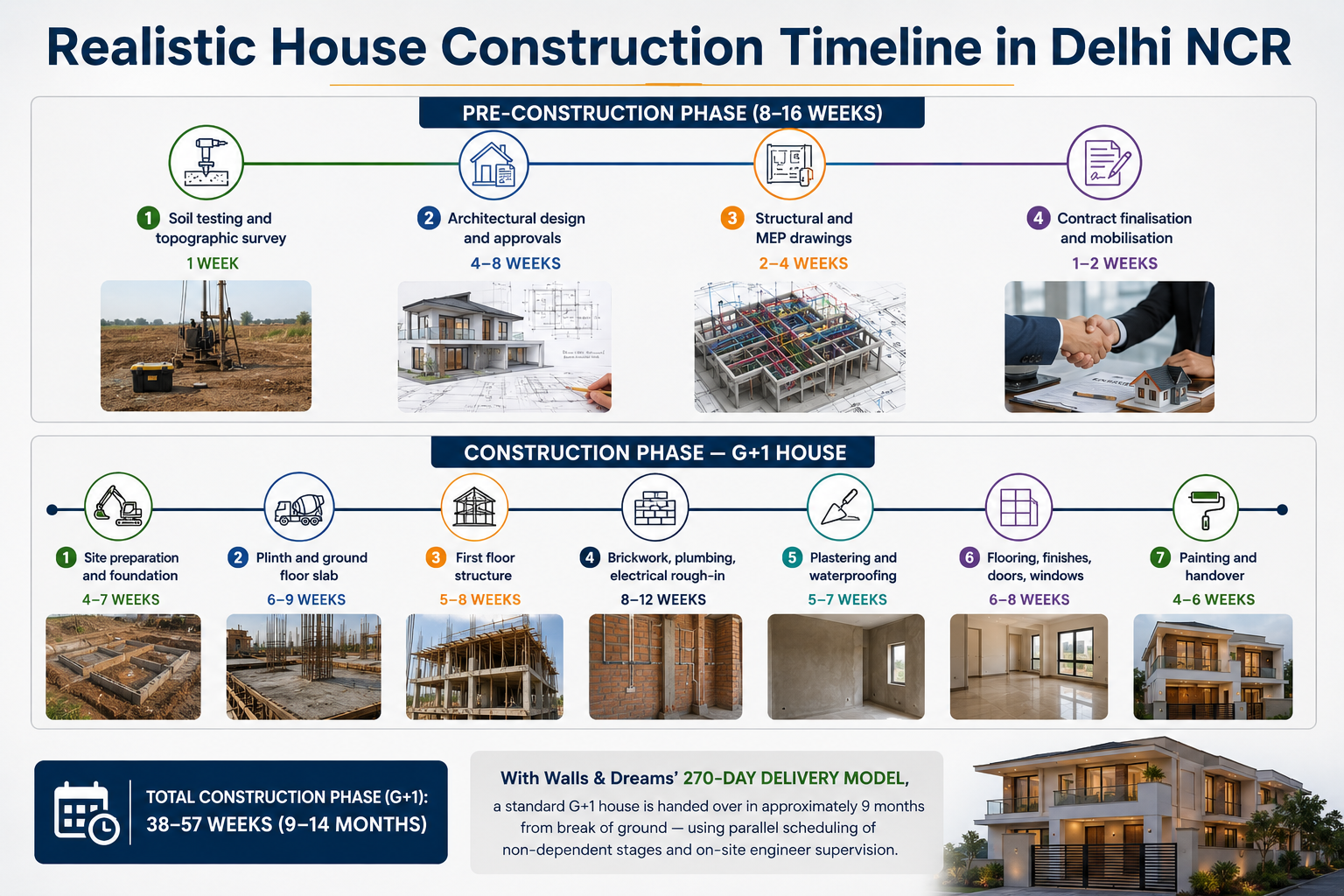
Pre-Construction Phase (8–16 weeks)
- Soil testing and topographic survey: 1 week
- Architectural design and approvals: 4–8 weeks
- Structural and MEP drawings: 2–4 weeks
- Contract finalisation and mobilisation: 1–2 weeks
Construction Phase — G+1 House
- Site preparation and foundation: 4–7 weeks
- Plinth and ground floor slab: 6–9 weeks
- First floor structure: 5–8 weeks
- Brickwork, plumbing, electrical rough-in: 8–12 weeks
- Plastering and waterproofing: 5–7 weeks
- Flooring, finishes, doors, windows: 6–8 weeks
- Painting and handover: 4–6 weeks
Total construction phase (G+1): 38–57 weeks (9–14 months)
With Walls & Dreams’ 270-day delivery model, a standard G+1 house is handed over in approximately 9 months from break of ground — using parallel scheduling of non-dependent stages and on-site engineer supervision.
What Causes the Most Delays?
- Late design decisions (client changes scope mid-construction): adds 4–12 weeks
- Material supply chain issues (imported tiles, custom joinery): adds 2–6 weeks
- Labour absenteeism during festivals: adds 2–3 weeks
- Rain damage to partially cured work: adds 1–4 weeks
- Rework due to poor quality control on the previous stage: adds 4–8 weeks
The pattern is clear: delays are mostly predictable and preventable with better planning, better supervision, and fixed-scope contracts.
How to Keep Your Build on Schedule
- Lock your design completely before construction starts. Even one undecided room layout will cascade delays.
- Choose a contractor with an in-house team, not a sub-contractor model. Sub-contracting introduces dependencies you cannot control.
- Ask for a Gantt chart or stage-wise milestone schedule with sign-off dates at contract signing.
- Visit the site weekly and ask for daily photo updates. Visibility prevents slippage.
- Do not make material changes after a stage has started. Changes mid-pour or mid-tile add weeks.
Start on the Right Timeline
Ready to plan your home construction? Use our free cost estimator to get a project size estimate, or talk to our team about a realistic build schedule for your plot.
Also read: Stages of House Construction Explained (Step by Step) | How Much Does It Cost to Build a House in Delhi NCR?