

The Decision Most Homeowners Make Without Enough Information
When you decide to build a home in Delhi NCR, you face an early choice that will define your experience for the next 12–18 months: hire an architect separately, then hire a contractor — or hire a single design-build firm that does both.
Most people default to the traditional route because that’s what they’ve seen. Hire the cheapest labour contractor, source your own materials, and ‘save money.’ The reality for many is cost overruns, poor quality control, and a timeline that stretches well past what was promised. Let’s examine both models honestly.
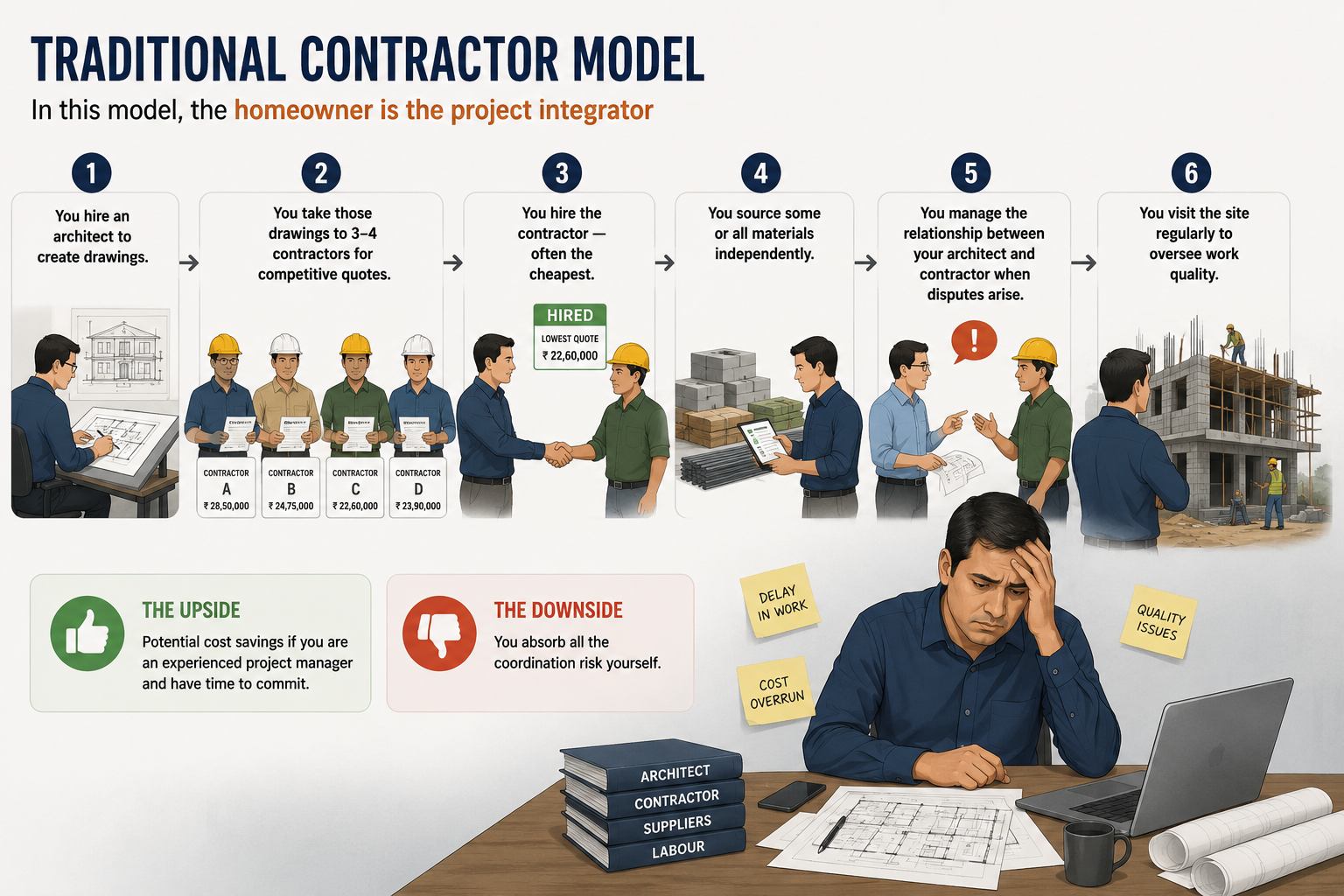
What Is the Traditional Contractor Model?
In the traditional model, the homeowner acts as the project integrator. The typical flow looks like this:
- You hire an architect to create drawings.
- You take those drawings to 3–4 contractors for competitive quotes.
- You hire the contractor — often the cheapest.
- You source some or all materials independently.
- You manage the relationship between your architect and contractor when disputes arise.
- You visit the site regularly to oversee work quality.
The upside is potential cost savings if you are an experienced project manager and have time to commit. The downside is that you absorb all the coordination risk yourself.
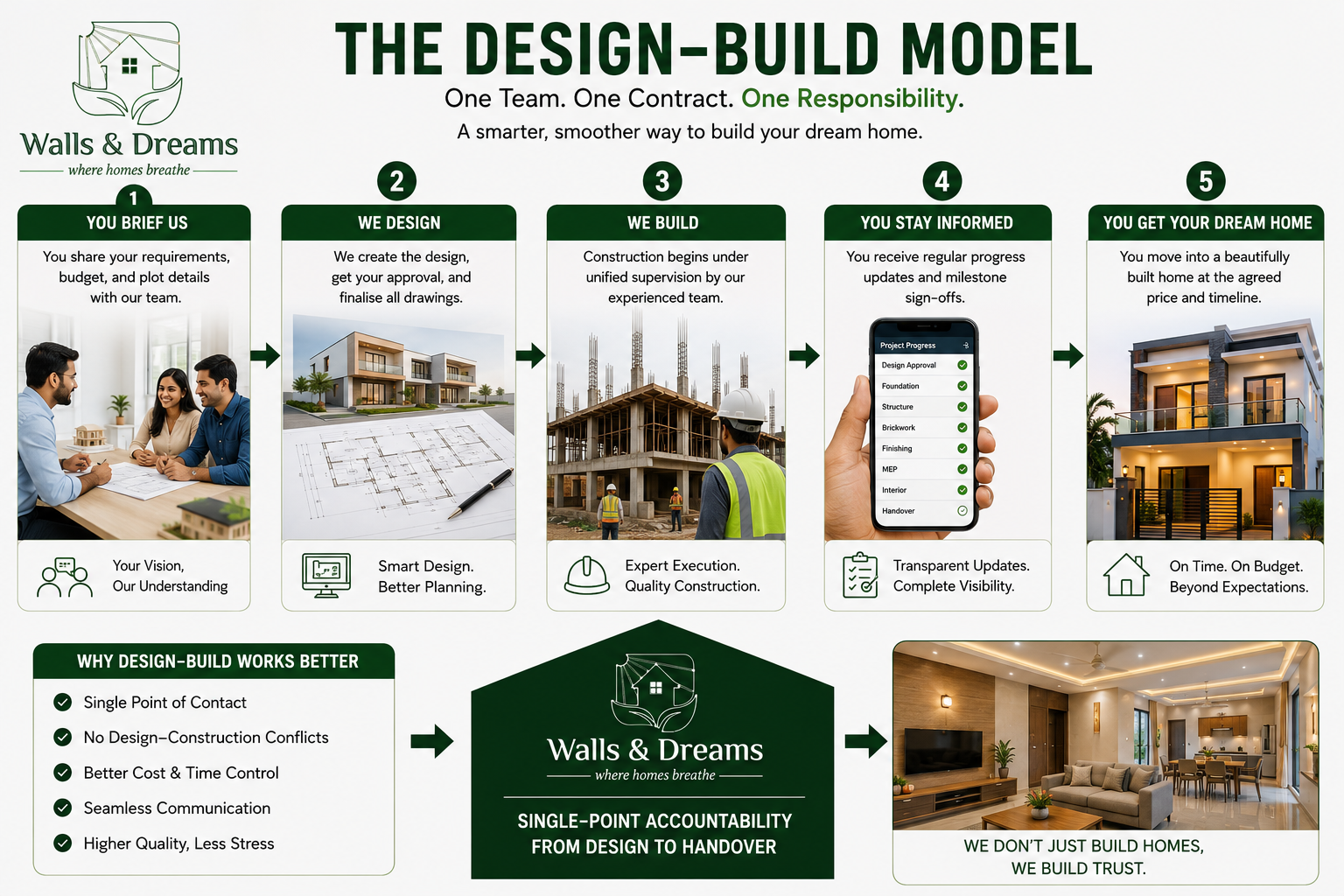
What Is the Design-Build Model?
In the design-build model, a single company is responsible for both design and construction under one contract. The architect, structural engineer, and construction team are part of the same organisation — or have a long-standing, tested working relationship.
The flow is simpler:
- You brief the design-build firm on your requirements, budget, and plot details.
- They produce the design, get your approval, and finalise drawings.
- Construction begins under unified supervision.
- You receive progress updates and milestone sign-offs.
- You get a finished home at the agreed price and timeline.
At Walls & Dreams, our how-it-works process follows exactly this sequence — single-point accountability from design to handover.
Head-to-Head Comparison
Cost
- Traditional (labour-only): Lower upfront contractor cost, but higher material waste, rework expenses, and your own time cost. Many self-managed builds end up 15–25% over budget.
- Design-Build: Fixed or milestone-based pricing. What you’re quoted is close to what you pay — material procurement, wastage control, and stage supervision are baked in.
- Verdict: Design-build wins on total cost for most homeowners. Labour-only wins only if you are a construction professional yourself.
Timeline
- Traditional: Average G+1 build takes 14–18 months due to coordination gaps between architect, contractor, and owner.
- Design-Build: Integrated teams typically complete the same project in 10–13 months. Walls & Dreams’ benchmark is 270 days for a standard G+1 build.
- Verdict: Design-build is consistently faster.
Quality Control
- Traditional: Quality depends entirely on which supervisor shows up on a given day. No formal quality gates between stages.
- Design-Build: Structured stage completion sign-offs, dedicated site engineer (not a sub-contractor), and regular third-party checks. Daily photo reports replace hearsay.
- Verdict: Design-build has systematic quality control.
Accountability
- Traditional: When something goes wrong — a leaking slab, a misaligned wall — the architect blames the contractor, the contractor blames the material, and you’re stuck in the middle.
- Design-Build: Single point of accountability. One company, one contract, one warranty.
- Verdict: Design-build wins decisively.
Flexibility and Customisation
- Traditional: More flexibility to change contractors or materials mid-project — though this usually results in delays and disputes.
- Design-Build: Design is finalised upfront, so changes mid-build are limited. This is actually an advantage — it forces better planning at the start.
- Verdict: Traditional wins slightly for clients who want to iterate through construction. Design-build wins for clients who want a planned, predictable outcome.
Who Should Choose Which?
Choose traditional contracting if:
- You have direct construction industry experience and can supervise daily.
- You are building a very small structure (single room, boundary wall) where coordination is minimal.
- You have a trusted local contractor with a proven track record and want to personally manage materials.
Choose design-build if:
- This is your first home build and you want a predictable, guided process.
- You have a job or business that limits your availability for daily site visits.
- You want fixed pricing, a guaranteed timeline, and post-handover support.
- You want your architect and construction team working as a unit, not in conflict.
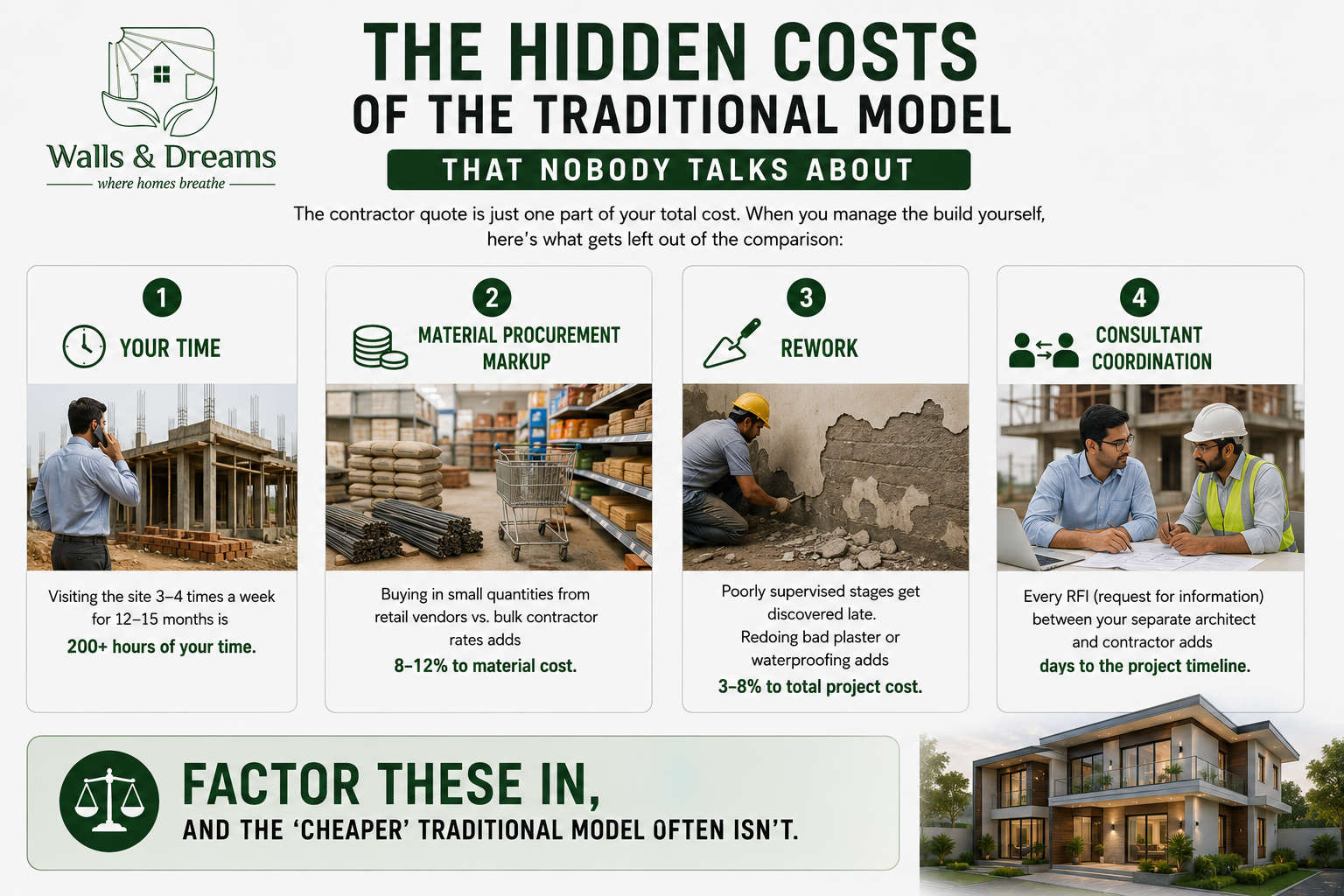
The Hidden Costs of the Traditional Model That Nobody Talks About
The contractor quote is just one part of your total cost. When you manage the build yourself, here’s what gets left out of the comparison:
Your time: visiting the site 3–4 times a week for 12–15 months is 200+ hours of your time.
- Material procurement markup: buying in small quantities from retail vendors vs. bulk contractor rates adds 8–12% to material cost.
- Rework: poorly supervised stages get discovered late. Redoing bad plaster or waterproofing adds 3–8% to total project cost.
- Consultant coordination: every RFI (request for information) between your separate architect and contractor adds days.
Factor these in, and the ‘cheaper’ traditional model often isn’t.
Ready to Experience the Design-Build Difference?
Walls & Dreams is Delhi NCR’s trusted design-build partner for custom homes. Explore our construction services or talk to our team about your plot and requirements.
Also read: Stages of House Construction Explained | How Long Does It Take to Build a House in India?