

That ₹1,500/Sq. Ft. Number Is Not Real
If you’ve been Googling construction costs in Delhi NCR, you’ve probably seen the ₹1,500–2,500/sq. ft. figure floating around. Don’t build a budget around it.
That number was last accurate around 2018. Steel has jumped. Sand prices have doubled in parts of NCR. Labour in Noida costs 30% more than it did four years ago. Anyone quoting you ₹1,500/sq. ft. today is either doing something very wrong or planning to surprise you halfway through the build.
Here’s what ground reality looks like in mid-2026.
What Does Your Budget Actually Get You?
Under ₹2,400/sq. ft. — Basic Construction
At this budget, you’re getting the bare structure. Standard red brick or fly ash walls, plain vitrified tiles, aluminium windows, OBD paint, and basic CP fittings. No false ceiling, no premium waterproofing, no branded bathroom fittings.
Who builds at this spec? Mostly people putting up a structure for rental income or family accommodation — not a home they plan to live in long-term. The hidden cost: skimping on
waterproofing and plastering at this tier leads to visible problems within 3–5 monsoon seasons. Fixing that later costs more than doing it right the first time.
₹2,500–3,100/sq. ft. — Standard Construction
This is what most homeowners actually build in Noida and Greater Noida. AAC block walls, UPVC windows, Jaquar or Hindware fittings, vitrified tiles throughout with marble in the living area, two-coat putty finish with emulsion paint.
Solid construction that’ll last 30+ years without major maintenance headaches — if supervised properly. This is the tier most of Walls & Dreams’ client builds fall into.
₹3,200–3,800/sq. ft. — Premium Construction
Italian marble or engineered wood floors. Imported CP fittings. Concealed AC with dedicated chase provisions. Home automation. Aluminium composite panel cladding on the facade. Landscaped terrace with drainage and irrigation.
These aren’t just aesthetic choices — they add significant time to the project too. Custom joinery, imported tiles with 8-week lead times, and automation wiring all need to be planned well before construction starts.
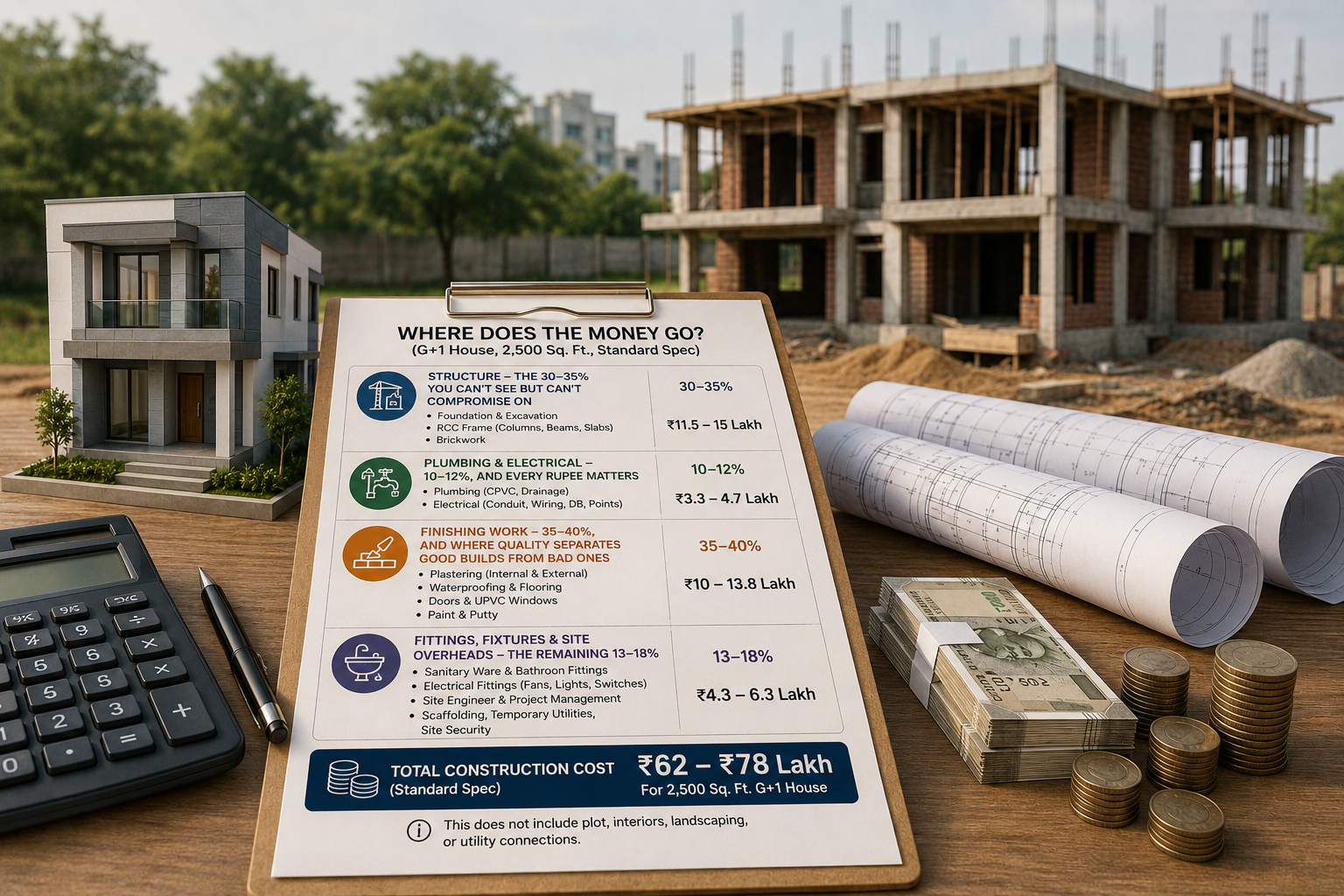
Where Does the Money Go? (G+1 House, 2,500 Sq. Ft., Standard Spec)
These are real cost ranges based on current 2026 rates in Noida and Greater Noida — not estimates pulled from an outdated BOQ template.
Structure — the 30–35% you can’t see but can’t compromise on
Foundation and excavation will run you ₹2.5–3.5 lakh. The RCC frame — all your columns, beams, and floor slabs — is the single biggest ticket item at ₹7–9 lakh. Brickwork to fill the panels adds another ₹2–2.8 lakh.
Together this is roughly ₹11.5–15 lakh just to get four walls and a roof in the air. Nothing is visible yet. This is also the stage where the worst shortcuts get taken, because nothing looks wrong on the surface.
Plumbing and electrical — 10–12%, and every rupee matters
Concealed CPVC supply lines and drainage: ₹1.8–2.5 lakh. Electrical conduit, wiring, DB boxes, and all circuit points: ₹1.5–2.2 lakh.
These numbers seem manageable — until you realise that any rework after plastering means breaking walls. A single missed pipe chase post-handover can cost ₹25,000–40,000 to fix. Get the layout right the first time.
Finishing work — 35–40%, and where quality separates good builds from bad ones
Plastering (internal and external): ₹2.5–3.5 lakh. Waterproofing and flooring: ₹3–4.5 lakh. Doors and UPVC windows: ₹2.5–3.8 lakh. Paint and putty: ₹1.8–2.5 lakh.
This is the 40% that determines how your home looks and feels every single day. It’s also where builders cut corners most aggressively — thin plaster coats, no flood testing before tiling, cheap putty that bubbles in humidity. Don’t let supervision slip here.
Fittings, fixtures, and site overheads — the remaining 13–18%
Sanitary ware and bathroom fittings: ₹1.2–2 lakh. Electrical fittings — fans, lights, switches: ₹80,000–1.2 lakh. Site engineer and project management: ₹1–2 lakh. Scaffolding, temporary water and power, site security: ₹50,000–1 lakh.
Add it up for a 2,500 sq. ft. G+1 at standard spec: somewhere between ₹62 and ₹78 lakh in pure construction cost. That doesn’t include plot, interiors, landscaping, or utility connections — more on that below.
Current Material Rates — June 2026
Prices as of this month in Delhi NCR. These shift — sometimes significantly — month to month based on steel futures and sand availability.
- OPC Cement (50kg): ₹380–420
- TMT Steel, Fe 500 grade: ₹62–68/kg
- AAC Blocks (600×200×100mm): ₹42–50/piece
- River sand (per brass): ₹4,500–6,000
- 20mm aggregate (per brass): ₹2,500–3,500
- Vitrified tiles, 600×600 standard grade: ₹45–80/sq. ft.
- UPVC windows: ₹350–550/sq. ft.
Of your total build cost, roughly 55–60% goes on materials, 25–30% on labour, and 10–15% on supervision and overheads. Steel and cement are the volatile ones — a 12-month build can see either move 10–15%. Put a price escalation clause in your contract, capped at 5%. Beyond that, it’s the contractor’s problem, not yours.
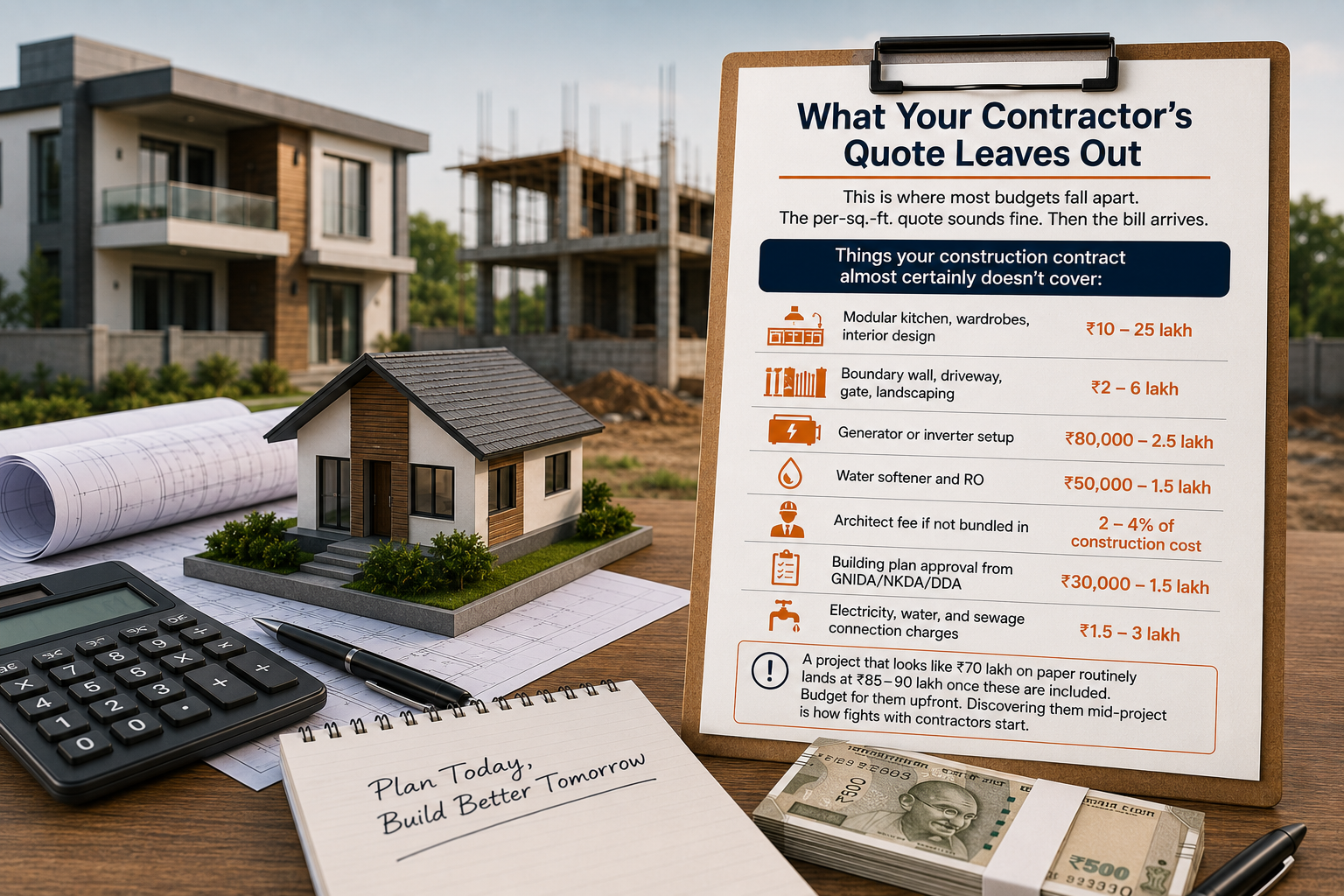
What Your Contractor’s Quote Leaves Out
This is where most budgets fall apart. The per-sq.-ft. quote sounds fine. Then the bill arrives.
Things your construction contract almost certainly doesn’t cover:
- Modular kitchen, wardrobes, interior design: ₹10–25 lakh depending on scope
- Boundary wall, driveway, gate, landscaping: ₹2–6 lakh
- Generator or inverter setup: ₹80,000–2.5 lakh
- Water softener and RO: ₹50,000–1.5 lakh
- Architect fee if not bundled in: 2–4% of construction cost
- Building plan approval from GNIDA/NKDA/DDA: ₹30,000–1.5 lakh
- Electricity, water, and sewage connection charges: ₹1.5–3 lakh
A project that looks like ₹70 lakh on paper routinely lands at ₹85–90 lakh once these are included. Budget for them upfront. Discovering them mid-project is how fights with contractors start.
Getting a Number That’s Actually Accurate
A rough per-sq.-ft. calculation is fine for a back-of-envelope sanity check. For anything you’d actually sign off on, you need five inputs:
- Plot dimensions and area
- Total floor area you want to build across all floors
- Which spec tier — basic, standard, or premium
- Any non-standard items: basement, terrace garden, home automation, swimming pool
- Current steel and cement rates on the date of estimation
We run a free cost estimate for your specific plot and floor plan. Quick version: use the online cost calculator. For a full BOQ with stage-wise breakdown, talk to our team directly.
Five Things That Prevent Budget Blowouts
Most overruns are predictable. Here’s how experienced homeowners avoid them:
- Freeze the design before you break ground. Every change you make during construction costs 3–5x what it would cost on the drawing board. One bathroom shift mid-build can set you back ₹40,000–80,000.
- Demand a BOQ at contract signing — not a lump sum. A lump sum contract hides exactly the items that balloon later. Line items keep everyone honest.
- Negotiate a steel and cement price lock, or a cap on escalation at 5%. Your build will span 9–12 months. Commodity prices can move significantly in that window.
- Don’t negotiate waterproofing down. A terrace that leaks will cost you ₹4–6 lakh to fix after possession — tearing up the terrace, redoing the membrane, re-laying the screed and tiles. Pay for it properly upfront.
- Build the structure to spec first. Upgrade finishes later. The modular kitchen can wait. A weak column cannot be fixed without demolition.
One Final Number Worth Knowing
Walls & Dreams has built over 1 lakh sq. ft. across Noida, Greater Noida, and Gurgaon — all on fixed-milestone contracts, all with full BOQ transparency. If you want to know exactly what your home will cost before signing anything, talk to our team or run a quick estimate on the calculator.
Also read: Stages of House Construction Explained | Plot Selection Guide: What to Check Before You Buy