

Why Plot Selection Is the Most Important Decision You’ll Make
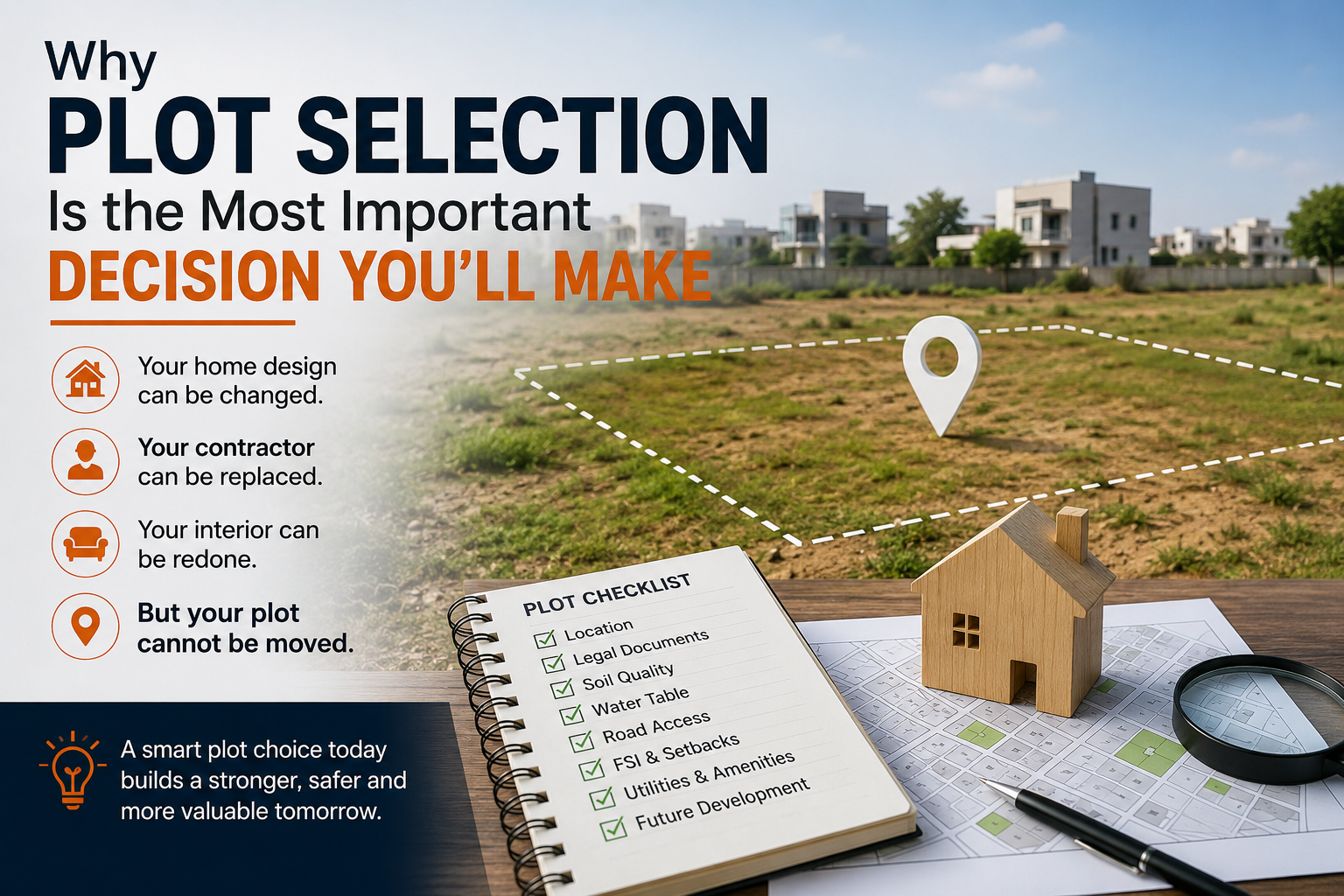
Your home design can be changed. Your contractor can be replaced. Your interior can be redone. But your plot cannot be moved.
A poorly selected plot can limit how much you can build, cost you years in legal disputes, create permanent waterlogging problems, and reduce the resale value of the finished property. Yet most buyers spend more time researching which tiles to use than which plot to buy. This guide will help you ask the right questions before any money changes hands.
1. Title and Ownership Documents
This is the most critical check and the one most likely to be glossed over.
- Verify the title chain for at least 13 years (30 years for higher security). Multiple ownership transfers increase the risk of encumbrance.
- Check for a clean Encumbrance Certificate (EC) from the Sub-Registrar’s office. Any mortgage, lien, or litigation shows up here.
- Confirm the plot is freehold, not leasehold. Leasehold plots in Delhi have annual ground rent obligations.
- Confirm the plot is in the seller’s name on the latest Khata or Property Tax receipt.
Do not rely on the broker’s assurances. Engage a property lawyer for independent title verification. This costs ₹5,000–20,000 and can save you lakhs.
2. Land Use and Zoning
A plot zoned for residential use on the Master Plan is the only legally safe option for home construction. Agricultural land (abadi land, khasra land) may be cheaper, but construction on it is either illegal or requires expensive conversion.
- Check the Delhi Master Plan 2041 or GNIDA/NKDA zonal development plan for the area.
- Residential zones: R1 (plotted), R2 (higher density plotted), Group Housing.
- Mixed-use and commercial zones may allow residential construction but with different building byelaws.
In Greater Noida and Noida, verify the allotment letter from the authority (GNIDA/NKDA) for residential use.
3. Permissible FAR / FSI and Ground Coverage
FAR (Floor Area Ratio) or FSI (Floor Space Index) determines how much total built-up area you are allowed to construct on your plot.
For example, if your plot is 200 sq. yd. (1,800 sq. ft.) and the permissible FAR is 2.0, you can legally build up to 3,600 sq. ft. of floor area.
- In Delhi: FAR for plots between 50–500 sq. yd. is typically 2.0 to 3.5 depending on plot size and zone.
- In Noida: Base FAR is 2.0 for plotted residential; premium FAR can be purchased.
- In Gurgaon: Sector-wise byelaws apply; FAR varies from 1.75 to 4.0.
Always verify the applicable FAR before you design your home. Many buyers find that their dream 4,000 sq. ft. home is not permissible on the 250 sq. yd. plot they purchased.
Our team can help you understand what you can build on your plot before construction begins. Talk to our experts.
4. Plot Shape and Orientation
A rectangular north-south or east-facing plot is the most efficient to design for both Vastu compliance and natural light. Irregular shapes, acute angles, or T-junctions create design constraints that increase construction cost per square foot.
- North or East-facing plots are preferred in most Indian traditions and also maximise winter sunlight inside the home.
- Avoid plots with acute angles below 60 degrees — these create unusable corners.
- Road-facing width should be at least 40–50% of the plot depth for functional front setback and parking.
Corner plots offer better natural light and ventilation but may have multiple setback requirements reducing buildable area.
5. Setback Requirements
Local byelaws mandate minimum setbacks — the distance between your construction and the plot boundary. These reduce your effective buildable footprint.
For a 200 sq. yd. plot in Noida, typical setbacks are: 3m front, 1.5m rear, 1.5m side. This means your actual ground floor footprint is significantly smaller than the plot area.
Calculate the buildable envelope before buying. For small plots, setback requirements can eat up 25–30% of ground coverage.
6. Soil Quality
The soil type directly affects your foundation design and cost. Weak or expansive soil (black cotton soil, filled land) requires deeper or costlier foundations.
- Get a soil test done before purchase if the plot is in an area with mixed soil profiles or is near a drain or nala.
- Filled plots (old quarries, low-lying areas built up with debris) are the most problematic — often showing poor bearing capacity and settlement over time.
- In sectors of Greater Noida and some parts of Gurgaon, water table is high — requiring waterproofing for any basement construction.
A basic soil test costs ₹3,000–8,000. It is the cheapest insurance you can buy.
7. Water Table Depth
High water table creates permanent risk for basements, ground floor storage, and even foundations. Before buying, ask neighbours about waterlogging during monsoon.
In parts of Noida Sectors 134–150 and Greater Noida West, the water table is between 3–6 metres. A basement here requires robust waterproofing and pumping systems — adding ₹8–15 lakh to your construction cost.
8. Connectivity to Water, Sewage, and Power
- Check if municipal water supply is available, or if the area is tanker-dependent.
- Confirm that the plot is within the sewage network. Otherwise, you will need a septic tank.
- Verify 3-phase electricity availability for the area from the local discom.
In new sectors and colonies, these connections may be 2–3 years away. Factor in the cost of interim arrangements.
9. Road Width and Access
The width of the road fronting your plot determines what maximum floor count is permissible in many byelaws. In Delhi, for example, a 4th floor requires a minimum 12-metre wide road in front.
Also check if the road is kachcha (unpaved) or pakka. A kachcha road in a new colony means years of dust, difficult material access during construction, and risk that the access road may be disputed.
10. Neighbourhood Infrastructure and Future Development
Check the authority’s sector development plan. A currently quiet plot next to a planned commercial zone may become noisy within 3 years. Conversely, a plot near a planned metro station or highway upgrade will appreciate significantly.
11. Physical Verification
Never buy a plot based on a site plan alone. Physically walk the plot, check for:
- Any encroachment or compound wall built by a neighbour beyond the boundary.
- Overhead power lines crossing the plot (these require clearance certificates for construction).
- Underground cables or utilities that may pass through the plot.
- Natural drainage pattern — does water flow into or away from the plot during rain?
12. Price Per Square Yard vs. Total Cost of Ownership
A plot at ₹40,000/sq. yd. with weak soil, high water table, and no municipal water connection may cost more to build on than a ₹55,000/sq. yd. plot with clean title and ready infrastructure.
Always calculate the total cost: plot + foundation upgrade + infrastructure + time to possession. The cheapest plot is rarely the cheapest home.
Start Your Home Journey on Solid Ground
Once you’ve found the right plot, Walls & Dreams can take it from design to delivery. Learn about our turnkey home construction process or use our cost calculator to estimate your build budget.
Also read: How Much Does It Cost to Build a House in Delhi NCR? | Design-Build vs. Traditional Contractor