
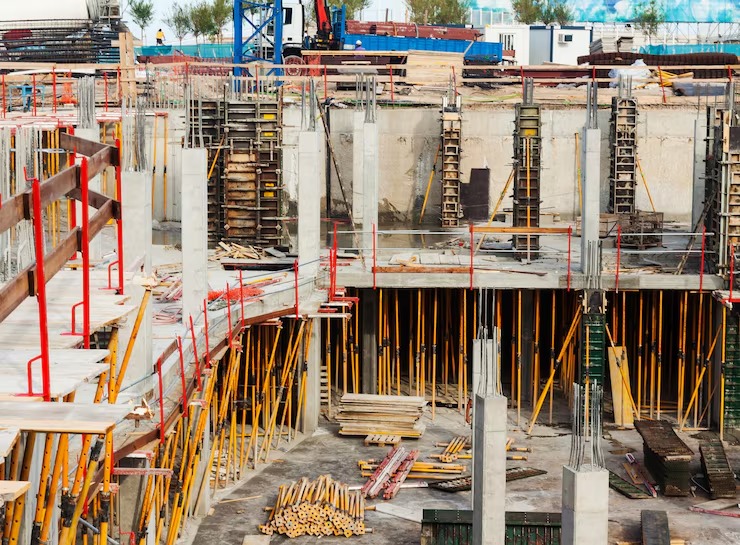
Footings are considered to be one of the most important structural components in house construction as they contribute to the stability, durability and long-term safety of any building. To the home owners, builders and anybody who intends to engage Walls and Dreams; it is important to learn the utility of the footings due to the fact that it is the sole load bearing foundation of the structure. A home that is not built on proper footings is prone to settlement problems, cracks and even structural collapse.
This step-by-step guide will discuss the meaning of footing, its importance, the different types of footing in construction, and the entire process of footing construction. We shall also explain how the correct house building materials influence the quality and strength of your foundation.
Understanding Footings in House Construction
Footings are the structural base that supports the foundation of a building. They properly distribute the weight of the structure into the earth. Consider the footings to be the part that keeps your home in a stable place, even after the soil around your house changes because of moisture, temperature, or pressure.
In contemporary house construction, the footing of the building should be designed on the basis of the type of soil, load requirements, and architectural plan. At Walls and Dreams, the aim is to make sure that all the footing is done in a manner that can assure long-term stability, making the building strong enough to stand over decades.
Why Footings Are Essential in Modern House Construction
Footings perform several critical functions that make them indispensable:
1. Load Distribution
One of the main purposes of footing construction is to distribute the weight of the building evenly across a larger area. This prevents excessive pressure on one spot and reduces the risk of foundation settlement.
2. Elimination of Structural Damage
A soundly engineered footing will make sure that the building does not move, tilt or sink. This prevents cracks or unequal settling of walls, floors and structural elements.
3. Soil Stability Management
Since different soils have different bearing capacities, footings act as stabilizers that adapt to the soil conditions beneath the building.
4. Enhancing Durability
Long-lasting homes depend heavily on high-quality footings. With the right house construction materials, homeowners can significantly increase the lifespan and stability of their property.
Types of Footing in Construction
Understanding the types of footing in construction is essential before beginning any residential project. Each type is used for specific soil conditions and building designs.
1. Isolated Footing
Isolated footings support individual columns. These are commonly used when column loads are moderate and spaced apart. They are the simplest and most widely used in house construction.
2. Combined Footing
Combined footings are used when two columns have very less space between them, to ensure that the load is evenly distributed. This helps especially in cases where a column is close to a boundary wall.
3. Strip Footing
Strip footings work constantly under load bearing walls. They fit well in small houses where the bearing capacity of the soil is moderate.
4. Raft or Mat Footing
In low bearing soils, a raft footing spreads over the whole building footprint and evenly allocates the weight. This also makes it one of the safest forms of footing in construction.
5. Stepped Footing
Stepped footings are used on sloped sites where the footing needs to be adjusted to maintain uniformity in level and load transfer.
6. Pile Footing
For extremely weak soil, pile footings transfer the load deep into the earth through long cylindrical columns. Though more complex, they provide exceptional support for heavy structures.
Walls and Dreams always recommends choosing footing types based on engineering evaluation rather than guesswork to ensure structural stability and safety.
The Footing Construction Process
Footing construction is a systematic process that should be handled and undertaken with accuracy in order to achieve dependable output. Below is the whole process:
Step – 1: Soil Testing and Site Analysis
A geotechnical investigation will show:
- Load-bearing capacity of soil
- Moisture content
- Soil type
- Necessary footing depth
This measure will keep the footing design inline with soil conditions.
Step – 2: Foundation Dig
After the layout gets completed, it is excavated according to the depth, shape, and size of the footing. The accuracy of excavation is crucial in alignment of structure.
Step – 3: Laying a PCC Bed
Plain Cement Concrete (PCC) is laid to provide a clean and level surface for reinforcement. It also protects steel bars from soil moisture.
Step – 4: Reinforcement Placement
Steel reinforcement bars are applied according to structural design. These bars resist tension forces and ensure overall stability. Proper spacing and tying are essential.
Step – 5: Formwork Installation
Formwork serves to keep the concrete in its shape until it becomes solid. Good house construction material and properly fixed shuttering ensure that the material leaks or deforms can be avoided in case of pouring.
Step – 6: Concrete Pouring
Pouring of the concrete is done cautiously to eliminate air bubbles or weaker points. Proper vibration ensures compactness and power.
Step – 7: Curing
Curing allows the concrete to achieve maximum strength. It takes approximately 7-14 days depending on the weather conditions.
Step – 8: Quality Inspection
Before building the foundation walls, the footing undergoes inspection to confirm:
- Alignment
- Proper curing
- Required dimensions
- Absence of cracks
Walls and Dreams ensures every footing meets structural standards and long-term durability requirements.
Essential House Construction Materials for Strong Footings
The strength of footings depends greatly on the quality of the house construction materials used. Some essential materials include:
1. High-Grade Concrete
The concrete should have the right grade (probably M20 to M30) to carry structural loads.
2. Reinforcement Steel
Tensile strength is provided by steel bars to resist the bending and cracking under load.
3. PCC Materials
A good PCC mix ensures a level and protective base for reinforcement.
4. Formwork Materials
The moulding and support to the concrete can be given through leak proof and durable formwork.
5. Aggregates
Good concrete is dependent on clean and well graded aggregates.
During the construction of residential buildings, Walls and Dreams rely on high quality materials to produce safe, durable and reliable foundations.
Errors that should be Prevented during Footing Construction
A minor error in the construction of the footing may bring down the whole structure. The following are some of the pitfalls that one should avoid:
- Incorrect soil assessment
- Poor reinforcement layout
- Inadequate curing
- Using low-quality materials
- Excessive water in the concrete mix
- Incorrect footing dimensions
Walls and Dreams ensures that such errors are avoided through strict supervision and quality assurance practices.
Why Proper Footings Determine the Life of Your Home
Footings are not just the beginning of the building—they are the backbone of the entire structural system. They influence:
- Stability
- Safety
- Durability
- Load management
- Resistance to environmental changes
Whether you are building a small residential structure or a large multi-story house, every structure depends on solid and high quality footings.
Conclusion
Footings play a crucial role in the construction of a house because it lays the foundation on which the whole house is built. Homeowners will be able to make better decisions by learning the significance of footing construction, the different types of footing used in construction, the entire process of footing construction, and the significance of using good quality construction materials in house construction. Walls and Dreams also highlights the importance of robust and sustainable footings since they define the durability and safety of every home construction.