
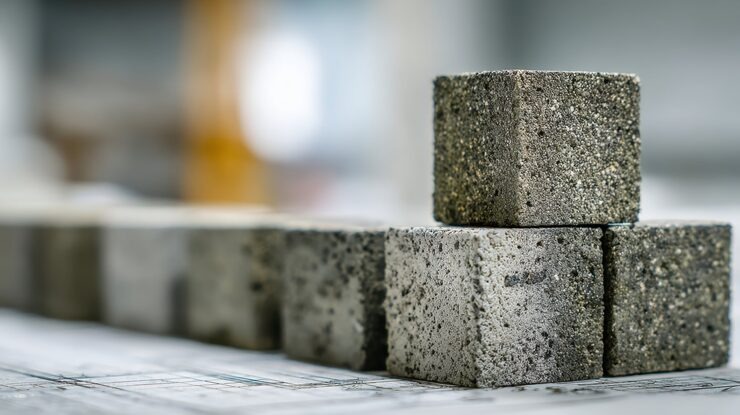
Indian construction is transforming quickly and one material controlling this change is UHPC concrete. Recognized for its exceptional strength, longevity and thin portfolio, this advanced building material is assisting engineers develop structures that were once thought impossible with classic concrete. In this article, Walls and Dreams breaks down what UHPC actually is, its features, blend design and where it is headed in India’s construction environment.
What is the UHPC Full Form?
Prior to diving deeper, it’s crucial to know the UHPC full form. UHPC is used for Ultra High Performance Concrete, a new-generation cementitious composite engineered to outperform classical and even high-strength concrete in almost every mechanical parameter. Compared to normal concrete, which typically achieves compressive strengths of 20 – 40 MPa, UHPC can exceed 150 MPa, making it an appropriate option for high-load and critical buildings. It was engineered to overcome key limitations of normal concrete — specifically its brittleness, permeability and low tensile strength. By optimizing its microstructure at the particle level, UHPC attains a level of density and cohesion that traditional blends can’t match.
Learning About Ultra High Performance Concrete
Ultra high performance concrete isn’t just “powerful concrete” — it is a fundamentally different composite material. It combines concrete, fine silica sand, silica fume, quartz flour, superplasticizers, water and steel or synthetic fibers in properly calculated proportions. The absence of coarse aggregate is one of its defining characteristics, which permits for a denser and more homogeneous matrix.
This concentration gives UHPC a distinct blend of properties:
- Extremely low porosity, which restricts water and chloride ingress
- Ability to be cast into slim, lightweight, yet load-bearing sections
- Higher protection against abrasion, freeze-thaw cycles and chemical attack
- High elasticity due to fiber reinforcement, decreasing brittle failure
Because of this performance portfolio, ultra high performance concrete is increasingly specified for bridges, façades, marine buildings and precast architectural components where durability and decreased maintenance gets priority.
UHPC Mix Design – The Science Behind the Power
A successful UHPC mix design depends on accuracy rather than bulk. Each element is selected to fill gaps at a microscopic scale, developing an almost impermeable matrix. Typical components of the collaborative design consist of:
- Cementitious binder – high-grade cement mixed with silica fume and sometimes fly ash or slag for improved pozzolanic reaction
- Fine aggregates – quartz sand or fine silica sand replacing coarse aggregate completely
- Fiber reinforcement – steel, glass or synthetic fibers (typically 1 – 3% by volume) to enhance tensile strength and elasticity
- Superplasticizers – utilized to achieve a very low water-to-cement ratio (mostly below 0.25) alongside maintaining usability
- Curing regime – steam curing or heat treatment is mostly applied to increase strength gain and decrease shrinkage
Getting the UHPC mix design correct needs proper lab tests, since even minor variations in particle size distribution or admixture dosage can greatly influence final strength and usability. This is why UHPC production is normally managed by specialized developers rather than produced on standard construction sites.
Main Characteristics of UHPC Concrete
The characteristics that differentiate UHPC concrete apart from classical materials consist of:
- Compressive strength – Ranges between 120 – 200 MPa, several times higher than regular concrete
- Tensile and flexural strength – Greatly improved because of fiber reinforcement, permitting slimmer structural sections
- Environmentally-friendly – Longer service life and decreased material volume can decrease lifecycle carbon footprint even after higher initial embodied energy
- Visual adaptability – Can be changed into intricate, slim and lightweight architectural forms without jeopardizing strength
- Longevity – Near-zero absorbency safeguards against rust, carbonation and chemical degradation
For infrastructure like coastal bridges and industrial flooring, that are subjected to rough environments, heavy traffic or improved service life needs, these characteristics make UHPC particularly appropriate.
Utilizations in Indian Construction
India’s infrastructure push — highways, metro corridors, smart cities and coastal constructions — is developing a strong need for high-performance materials. Basic uses consist of:
- Bridge girders and expansion joints needing heavy load capacity with decreased weight
- Precast architectural panels and façade cladding for contemporary business structures
- Repairing and strengthening of old buildings
- Industrial flooring subjected to heavy abrasion and chemical exposure
- Marine and coastal buildings requiring protection against silica water ingress
Future of UHPC in Indian Construction
The future of UHPC in India seems promising as infrastructure requirements grow more complicated. Government supported developments under initiatives such as the Bharatmala Pariyojana and the Smart Cities Mission are developing a strong desire for long lasting, low-maintenance building materials. As local manufacturing capacity expands and technical experience grows among building engineers, production costs are expected to reduce, making the material increasingly available beyond niche, high-budget projects.
Research facilities and material suppliers are also working on improving UHPC mix design using locally available materials, which could further decrease dependency on imported elements and bring down total development expenses. As sustainability rules tightens, the declined material usage and enhanced service lifecycle provided by UHPC could position it as a widely accepted option instead of a specialty product.
Conclusion
By providing unrivaled stability, longevity and design adaptability for contemporary infrastructure needs, UHPC cement showcases a major leap forward from conventional building materials. As India continues to finance in resilient, long-lasting structures, Walls and Dreams understands that UHPC concrete will play a vital role in changing the country’s development environment.
FAQs
How is UHPC concrete different from normal cement?
UHPC cement utilizes a denser combination without coarse aggregate, fiber reinforcement and a very less water-cement proportion, giving it far more sturdiness and longevity than normal cement.
What features influence UHPC mix design?
The UHPC blend design relies on binder kind, fiber composition, water-cement proportion, superplasticizer dosage and curing method, all of which influence entire strength and usability.
Is ultra high performance concrete cost-efficient for Indian projects?
Even though the starting cost is higher than normal concrete, ultra high performance concrete mostly proves cost-efficient over the building’s lifecycle due to decreased upkeep and longer service life.
Where is UHPC commonly utilized in India?
It is normally utilized in bridges, precast façade panels, industrial flooring and coastal or marine structures that need high longevity and protection against rough conditions.
What is the UHPC full form in terms of structure development?
UHPC is used for Ultra High Performance Concrete, a high-strength, low-penetrability hybrid material utilized in demanding building operations.