
Quick answer: A home needs about twelve basic building materials: concrete, steel, wood, brick, stone, glass, aluminium, plastic, cement, clay tiles, gypsum and bamboo. Concrete, steel, cement and brick form the structure. Wood, glass and aluminium go into doors and windows. Clay tiles, gypsum and bamboo serve roofs, ceilings and eco-friendly work.
“Home is where the heart is.” That’s why for a building to be tall there are some things that cannot be left out. Whether tall commercial towers or modest residential houses, construction resources contribute significantly to structures integrity. In this blog, I describe twelve types of materials that are required from the beginning to the end of any home construction.
12 Types of Building Materials Used in Construction
Each house has a foundation which is a building material. Here’s a breakdown of the top twelve materials essential for building construction:
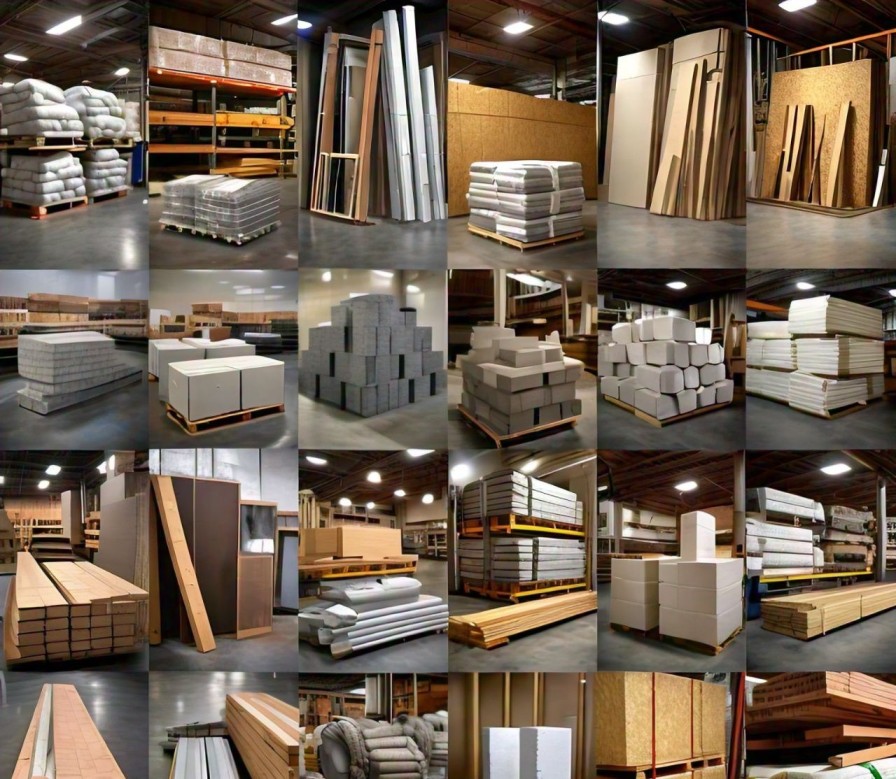
1. Concrete
Explanation: The type of construction material which is a mixture of cement, sand and gravel and water. It solidifies with time hence it makes a very durable construction material.
Applications: Material for foundations, slabs, beams, columns, intermediary barriers, and many more. With driveway sidewalks or roads it is equally a familiar occurrence.
2. Steel
Explanation: Iron base material with carbon content, which boasts of high tensile strength.
Applications: For construction of the buildings, especially their frameworks; in construction of concrete reinforcement; in construction of enormous structures such as skyscrapers, bridges and the like.
3. Wood
Explanation: A material from a natural source, nearly weightless, used for visual enhancement of objects and premises.
Applications: Applied in construction of house frames, doors and windows, furniture and floor boards. This also has aesthetic function.
4. Brick
Explanation: Bricks which are small in size but can be made from clay, sand or lime.
Applications: It involves use for walls, foundation as well as for partition. Bricks are strong and possess good thermal qualities also.
5. Stone
Explanation: It is more numeros, more inherent, and indeed much more resistant.
Applications: It can also be installed in cases where any type of structure is put up including the foundations, walls and ground floor. Some of the more frequently applied stones include granites, marbles, limestones and sandstones.
6. Glass
Explanation: Glass, a hard and smooth material obtained from silica, soda and lime.
Applications: Often installed in windows and doors, walls and floor, roofs and ceilings and in lights with provisions for holding light and beauty.
7. Aluminum
Explanation: Light metal which does not corrode easily.
Applications: Suitable for window frame, doors, roofing [roofing tiles], and cladding; most appropriate for locations close to the sea.
8. Plastic
Explanation: A man made material that synthesized with polymers.
Applications: For conduits, for electrical and other installations, for roofing and in fixtures because of its resistance to dampness and for its sturdiness.
9. Cement
Explanation: A very fine or very small particle that is created from both limestone and clay.
Applications: One of the significant items in construction calculations as used in making concrete and mortar in constructing foundations, walls, and plastering works.
10. Clay Tiles
Explanation: Underfloor tiles of burnt clay obtained directly from the soil.
Applications: Used for roofing and flooring. These tiles are particularly suitable for any climate type and they do not burn.
11. Gypsum
Explanation: A soft, fine-grained sulfate mineral comprises an important part of plasters.
Applications: Most commonly used in infrastructure such as in gypsum board or in walls or false ceiling.
12. Bamboo
Explanation: A novel material that has grown popular very quickly primarily due to its sustainability characteristic.
Applications: It is utilized in acting as the scaffold, floor, roof and most importantly used while constructing environmentally friendly structures.
Which material goes where in a house
The twelve materials above are easier to plan if you think of them by part of the building:
- Foundation, columns, beams and slabs: concrete, with steel reinforcement inside it and cement as the binder. Stone and brick are also used in foundations.
- Walls and partitions: brick or stone, laid in cement mortar and finished with cement plaster. Gypsum board is common for light partitions.
- Doors and windows: wood, aluminium, glass and plastic. Aluminium suits places close to the sea because it does not corrode easily.
- Roof and floor: concrete slabs, clay tiles for roofing and flooring, and stone such as granite or marble for floors.
- Ceilings: gypsum board for false ceilings.
- Plumbing and electrical: plastic conduits and fittings.
- Temporary work: bamboo is used for scaffolding, and in some eco-friendly structures.
For quantities, see our guide on how much material is required for a house. For the choice of cement and brick, read which cement is best for house construction and different types of bricks used in construction.
What to check when materials arrive on site
Good material can still go wrong between the shop and the wall. A few checks on delivery are worth the time:
- Cement: bags should be sealed and dry, with a recent packing date. Hard lumps in a bag mean it has taken moisture. Store bags off the ground and under cover.
- Steel: bars should be straight, clean and free of heavy flaking rust, and carry the maker’s marking.
- Bricks: they should be uniform in size and well burnt, without many broken pieces in the load.
- Sand and aggregate: keep them clean and separate. Mud or clay mixed in weakens concrete and mortar.
- Wood: it should be well seasoned and straight, without live cracks or signs of insects.
Common mistakes when buying building materials
- Buying on price alone. The cheapest cement, steel or tile often costs more once it is repaired or replaced.
- Ordering without a quantity list. Run short in the middle of a pour and you may get a different batch or brand for the rest.
- Ignoring local conditions. Coastal air, heavy rain or very hot summers change which material lasts. Choose for your site, not for a brochure.
- Storing materials badly. Rain on cement, or steel left standing in water, is waste you paid for.
- Skipping the engineer. Structural materials such as concrete grade and steel size should come from the structural drawing, not from the supplier.
Conclusion
Construction of the home entails some basic materials that are useful from the framework to the cover of the building. With the development of construction methods, there is a change taking place in substitution of a few conventional materials. These are the building materials that should be used in constructing any home to enhance endurance in constructing a house. Walls and Dreams emphasizes the importance of selecting high-quality materials to ensure the longevity and stability of your home.
Materials depend on budget as much as on use, so also read about low cost home construction materials, bamboo as a construction material and teak wood. To see how these materials add up to a budget, see our guide on residential construction cost per sq ft in India. If you want us to build with them, see our construction company page.
FAQs
What materials are employed for construction of a foundation of a building?
Both concrete and concrete blocks are very relevant in the laying of structure of a building.
Explain any aspects of the construction process which interests you.
Of course, concrete, cement, sand, brick, block and timber are some of the most used construction materials.