
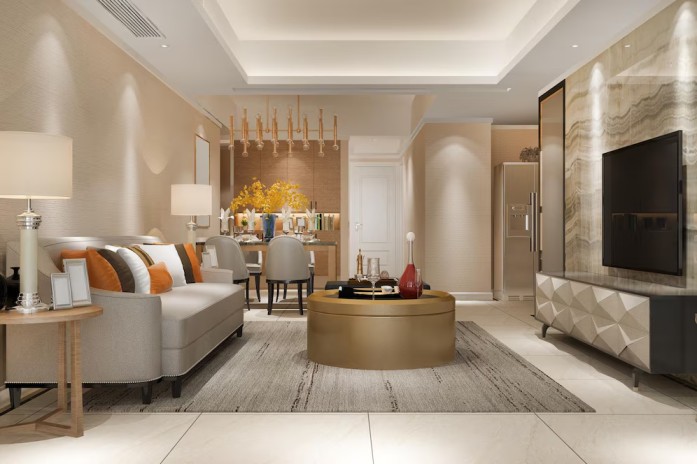
Quick answer: The main false ceiling light designs are flush lights, recessed lights, cove lights, chandeliers, pendants, gimbal spotlights, track lights and backlit panels. Most rooms need a mix: recessed or flush lights for general brightness, cove lighting for a soft glow, and a pendant, chandelier or spotlight where a feature is needed. Plan the wiring before the ceiling is closed.
A false ceiling hides the wiring, which makes it the easiest place in a room to build good lighting. The ceiling and the lights have to be designed together, because every fitting needs a position, a cable and in some cases a support before the boards go up. This guide covers the light types in use today, where each one works, and what to settle before the ceiling is closed.
What is a false ceiling?
A false ceiling, also called a dropped or secondary ceiling, is a second ceiling fixed below the main slab and hung from it on a suspended frame. It is commonly made of gypsum board or plaster of Paris (POP), and also of wood, particle board or aluminium panels. It improves the look of the room and hides wiring, pipes and ducts in the gap above.
Types of false ceiling lights
1. Flush lights
Flush lights sit flat against the ceiling surface. They are simple fittings used for general lighting. Use at least two in a room so the corners are not left dark.
2. Chandeliers
A chandelier is the centrepiece fitting for a living or dining room. Modern ones use LED lamps and come in many finishes. They are heavy, and a lightweight ceiling such as gypsum cannot carry them, so the support must come from the slab above.
3. Cove lights
Cove lighting uses strip lights placed inside a recess or ledge of the false ceiling, or behind a moulding, so the light washes across the ceiling and the source stays hidden. It gives the soft, warm glow seen in hotels. It works as accent or mood lighting.
4. Pendant lights
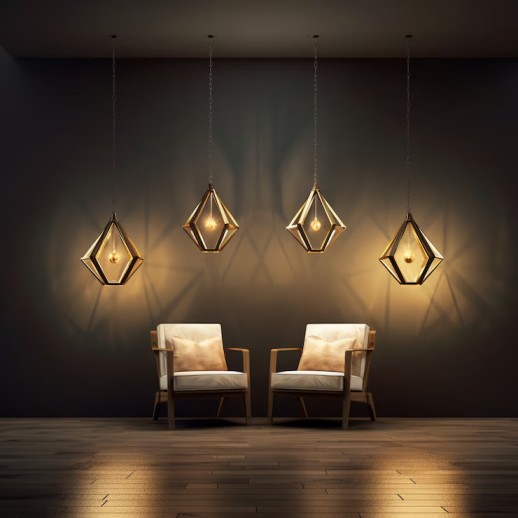
Pendants hang lower than other fittings. They are cheaper and easier to install than chandeliers, and they link the ceiling visually with the furniture below. They suit dining tables, kitchen counters, bedsides and room corners.
5. Recessed lights
Recessed lights are fitted into holes cut in the ceiling, so only the face is visible. They give a clean, minimal look, work as general or decorative lighting, and are the right choice where headroom is limited. They pair well with cove lights.
6. Gimbal lights
A gimbal light has a head that tilts and rotates, so the beam can be aimed. It is used as a spotlight or accent light to pick out artwork, a textured wall or an architectural feature. Recessed and surface-mounted versions are available.
7. Track lights
Track lighting carries several adjustable heads on one rail. The heads can be turned to different parts of the room, and the set gives enough light to serve as general lighting too. LED track heads need very little maintenance.
8. Backlit panels
Here a translucent panel in the ceiling is lit from behind, so the panel itself glows. It can be the main light or a decorative feature. The panels come factory-finished, which makes them quick to install.
Which light suits which room?
| Room | General light | Add for effect |
|---|---|---|
| Living room | Recessed or flush lights | Cove lighting; a chandelier or gimbal spots on a feature wall |
| Dining area | Recessed lights | Pendant or chandelier centred on the table |
| Bedroom | Cove lighting with a few recessed lights | Pendants at the bedside |
| Kitchen | Recessed or flush lights | Pendants over the counter; track lights for work areas |
| Passage, lobby | Recessed lights | Gimbal lights on artwork; backlit panel as a feature |
Think of the lighting in three layers: general light to see by, task light where you work or read, and accent light for mood. A room that has only the first layer looks flat however many fittings it has.
What to plan before the false ceiling is closed
- A lighting layout on the drawing: mark every fitting against the furniture plan, so lights end up over the table and the bed and not over empty floor.
- Frame and cut-outs: recessed lights must fall between the frame members. Fix the positions before the framework goes up.
- Support for heavy fittings: chandeliers and ceiling fans are carried by hooks in the slab, never by the false ceiling boards.
- Depth of the ceiling drop: coves and recessed fittings need clear space above. Tell the ceiling contractor which lights you want before the level is fixed.
- Separate switching: put general lights, cove lights and feature lights on different switches so each can be used alone.
- Access to drivers: LED strips and panels run on drivers. Keep them where they can be reached, so one failure does not mean cutting the ceiling open.
- Light colour: choose warm white for living rooms and bedrooms, and a cooler white where you work, such as the kitchen. Keep one tone within a room.
Common mistakes
- Filling the ceiling with a grid of recessed lights and nothing else, which gives glare without atmosphere.
- Putting every light in the room on one switch.
- Hanging a chandelier from the gypsum ceiling instead of the slab.
- Fixing LED strips where the individual dots are visible, instead of hiding them in the cove.
- Mixing warm and cool white fittings in the same room.
- Sealing the drivers above the boards with no access.
- Deciding the lights after the ceiling is painted.
Related guides
The ceiling shape decides which lights are possible, so look at the ceiling design alongside the lighting: see false ceiling designs for bedrooms, fall ceiling ideas for the main hall and ceiling designs for small bedrooms. If you prefer a bare or textured slab to a boarded ceiling, read about cement ceiling designs. False ceiling and lighting work is part of our interior design service.
Frequently asked questions
Which light is best for a false ceiling?
There is no single best light. Recessed and flush lights give general brightness, cove lights add a soft indirect glow, and pendants, chandeliers, gimbal spotlights or track lights highlight a table, wall or artwork. A good ceiling combines two or three of these on separate switches.
What is cove lighting in a false ceiling?
Cove lighting is a strip light hidden inside a ledge or recess of the false ceiling, so you see the glow and not the fitting. It gives a dim, diffused light and is used as accent or mood lighting, not as the only light in a room.
Can a chandelier be hung from a false ceiling?
Not from the false ceiling itself. Gypsum and other lightweight ceilings cannot carry the load. The chandelier must be supported from the concrete slab above, with the hook or support fixed before the false ceiling is closed.
Which lights suit a room with a low ceiling?
Recessed lights are the better choice where headroom is limited, because they sit inside the ceiling and do not hang down. They can be combined with cove lights. Avoid large chandeliers and long pendants in such rooms.
When should false ceiling lighting be planned?
Before the ceiling framework is fixed. Light positions, wiring routes, switch groups and supports for heavy fittings all have to be decided first. Changing them after the boards are fixed and painted means cutting and patching the ceiling.