
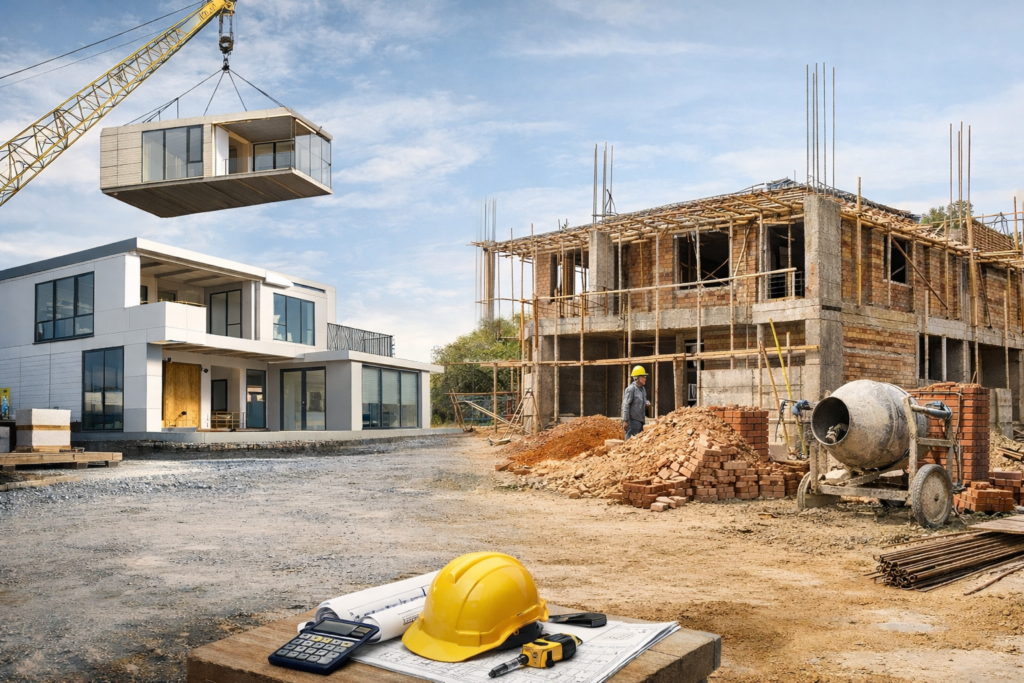
When deciding on a new house one of the greatest queries every homeowner asks is whether prefab construction is cheaper than using traditional house construction techniques. As budgets tighten and efficiency becomes a concern for many families throughout India, it is imperative to learn about both the approaches. At Walls and Dreams, we help homeowners make informed choices using modern insights, updated tools like a house construction cost calculator, and in-depth analysis of different building techniques.
This is a step-by-step guide that explains how prefab construction cost is calculated compared to what used to be incurred in traditional house construction, so that you are able to realize which one is better as far as money, time, longevity, design flexibility, and future costs are concerned.
Understanding Prefab Construction
Prefabricated construction or Prefab construction refers to a process that involves manufacturing of building parts in an off-site controlled environment and then carrying them to the site for assembling. Since the majority of the construction has been done at the factory, it cannot get affected by external conditions such as weather or on-site delays.
Cost transparency is one of the greatest benefits that homeowners get when using prefab projects. Since everything is pre-engineered and planned with precision, the budget stays predictable. Many homeowners now depend on a house construction cost calculator to compare expenses before finalizing a building approach.
Understanding Traditional Construction Methods
Conversely, the old fashioned ways of construction involve the construction process being conducted on-site in which materials, labor and design options are assembled progressively. For generations, this technique has been used in India, and it has no limits in terms of design, layout development and architectural style.
Nevertheless, traditional house construction is usually affected by real-time issues such as labor supply, weather conditions, rising and falling rates of materials and the overall project time. In order to control these variables successfully, homeowners tend to use a construction cost calculator to estimate costs and prevent budget overrun.
Cost Breakdown: Prefab vs. Traditional Construction
Let’s compare both methods through a detailed cost-centred perspective.
1. Material Costs
Prefab Construction
Manufacturers buy materials in large quantities which reduces wastage and results in minimized costs. The controlled factory environment greatly reduces the possibility of damage or delays that might add on the prefab construction costs.
Traditional Construction
Material prices vary depending on market conditions, demand, and location. In conventional methods of construction, you might need additional budget for wastage, breakage, storage and transportation. Homeowners usually monitor these variations with the help of a good construction costs calculator.
2. Labor Costs
Prefab Construction
Labor is streamlined and efficient. Workers follow a fixed procedure in a factory setup, meaning less time, fewer errors, and a predictable expense structure. These factors keep prefab construction costs consistent.
Traditional House Construction
A substantial portion of the budget goes into labor expenses. In the traditional house construction method, due to any delays because of weather, shortage of materials or field complications might lead to higher costs. Using a house construction cost calculator helps homeowners estimate these variations.
3. Time and Project Duration
Prefab Construction
A major advantage is speed. Since components are pre-made, the assembly on-site is quick—sometimes completed in weeks rather than months. A faster project timeline also means reduced overhead expenses.
Traditional Construction Methods
On-site building typically takes longer because construction progresses step by step. Although this gives it more flexibility in design, the long period can make it more expensive in terms of labor, equipment, and supervision. These time-related costs can be estimated beforehand with the help of a construction cost calculator.
4. Design Flexibility
Prefab Construction
The prefab designs that come nowadays are surprisingly customizable, yet do not always vary so freely as a standard on-site construction. It is difficult to make changes halfway through a construction, as parts were already made in advance.
Traditional House Construction
In this case, there are no limitations on design creativity. The layouts, elevation and material can also be customized at any point of the project. Homeowners who are constructing with Walls and Dreams frequently use a house construction costs calculator that allows them to determine the potential cost effect of each design change.
5. Long-Term Maintenance Costs
Prefab Construction
Prefab parts are more resistant to structural defects because their manufacturing occurs under a precision-based environment. This reduces maintenance and repair expenses over a period of time.
Traditional Construction Methods
The maintenance requirements can differ based on the quality of the material, the local weather, and also the construction methods. Periodical maintenance should also be planned, particularly in large houses. One of the tools that will be very helpful during the estimation of these long term costs will be a construction cost calculator.
Prefab vs Conventional Construction: Which Method is more Affordable?
The correct option can be chosen according to your priorities:
- Prefab construction costs can be more economical than you thought, particularly when it comes to speedy, predictable and efficient construction.
- When you want the absolute control of design, and want a house that is constructed by traditional means, traditional house construction might be the right choice, but overall cost may differ based on several site conditions.
No matter which option you select, comparing costs by using calculators such as a house construction cost calculator or a construction cost calculator will assist you in making a factual decision.
At Walls and Dreams, homeowners tend to compare the two methods adjacent to each other, so they can select a building procedure that will meet their budget, lifestyle, and long-term objectives.
Comparing Costs Through a Construction Cost Calculator
A professional house construction cost calculator or an advanced construction cost calculator allows you to input:
- Number of floors
- Built-up area
- Material quality
- Labor category
- Location
- Finishing level
Through this data, you will get an in-depth estimation of prefab building cost as well as the traditional building cost. This transparency allows planning more effectively and eliminates unpleasant surprises during the implementation.
What Approach Will the Homeowners prefer in the year 2026 and even later?
Prefab Construction Is Ideal If You Want:
- Faster project completion
- Reduced labor dependency
- Minimal wastage
- Stable pre-determined budgeting
- Modern energy-efficient designs
Traditional Construction Methods Are Better When You Need:
- Full design flexibility
- Custom architecture
- On-site supervision and adjustments
- Long-term expansion options
- Local material selection
Every homeowner has unique expectations. This is the reason why Walls and Dreams assists its clients through every step with updated tools such as construction cost calculator and the deep understanding of the industry to ensure that the budget is precise.
Conclusion
Prefab and traditional types of construction have their own strengths and benefits and the decision that should be made on the basis of your financial capacity, schedule and your design requirements. Prefab provides efficiency and certainty whereas traditional house construction grants flexibility and artistic choice. As the cost of construction increases across India, having tools such as a house construction cost calculator or a construction cost calculator came useful for homeowners as they provide a clear comparison between the cost of prefab construction and traditional construction. With careful consideration of both options, you will be able to create a home that fits your vision, budget and long-term lifestyle, particularly when you have the professional advice of Walls and Dreams.