
Quick answer: Plain cement concrete (PCC) is concrete made of cement, sand, coarse aggregate and water, with no steel reinforcement. It is laid as a flat, firm base under foundations, floors and pavements. The usual mix is 1:2:4. PCC costs less than RCC but has low tensile strength, so it cannot be used where a member will be in tension.
Concrete as a material has been in demand for many centuries in constructing and it has been regarded as a crucial material. That is, concrete can be defined as one of the forms of composites – phasis of cement and concrete aggregate – sand, gravel, and water. The strength of concrete thereby depends on cement, sand and the water cement ratio. Plain Cement Concrete (PCC) in other words can be defined as a perfect combination of cement and fine and coarse aggregates.
In this blog, we’ll learn about PCC and why it’s so important to construction. You’ll come across more details if you’ll read further.
What is PCC in Building Construction?
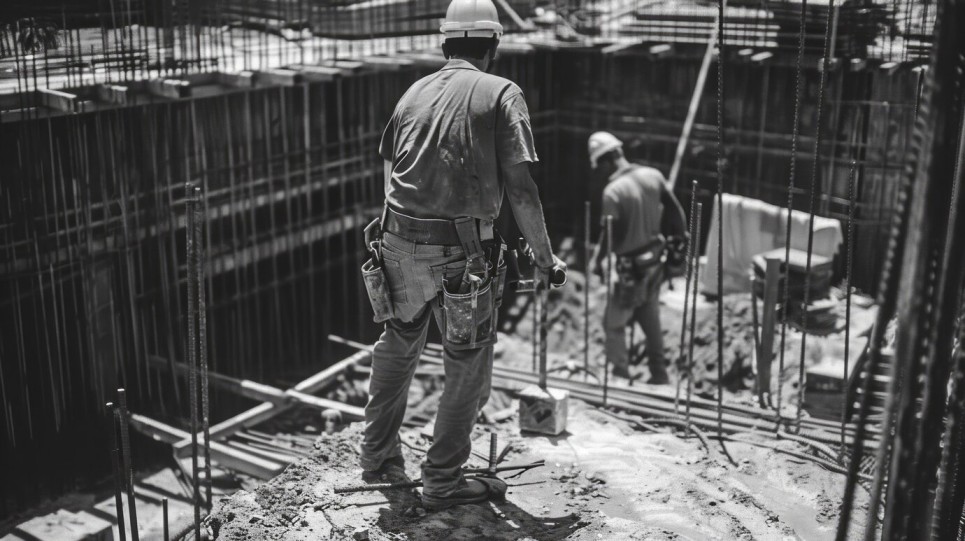
PCC in Building Construction
Concrete is one of the most important construction materials and one of the types used in construction is the PCC- Plain Cement Concrete. PCC has been implemented in various constructions regardless of the level of it being small projects and even major projects. The main use is to provide flat surfaces where structures necessary in construction cannot directly rest on the sand.
What is PCC in Construction?
PCC is one of the simplest building products and consists of cement, sand, gravels or crushed stones and water. In use primarily as a building material it also provides structural support to constructions. PCC plays an important role to minimize the chances of moisture related problems in structures and provide a proper rigid base.
Why is PCC Important in Construction?
PCC plays a vital role in construction for several reasons:
- Foundation Stability: PCC offers the foundation that is ideal because it disperses loads and minimizes the possibility of settlement.
- Moisture Barrier: It also functions as a barrier to effectively prevent harm that moisture can cause to the structure.
- Cost-Effectiveness: Cost wise, PCC is cheaper than reinforced concrete structures hence making the builders strike a good bargain when using PCC.
- Durability: : They bring long term lifespan benefits and are resistant to different types of nvironmental situations.
Materials Used in Plain Cement Concrete
Coarse Aggregate: These aggregates with size ranging from 4.75 mm to 150 mm includes gravels, crushed stones and slags. They should be washed clean with hard and well graded for strength and workability.
Fine Aggregate: Fine particle size, usually sand or smaller than sand, usually 4.75 millimeters in size. It will be useful to avoid them having boundaries of silt or clay in order to guarantee a good combination.
Cement: Cement acts as a binder. Usually, Portland cement is utilized with specific standards as the reference, such as IS 269 for India, or ASTM C150 for the United States of America.
Water: Used in the process of mixing concrete requirements, water has to be relatively free from impurities in order not to compromise the setting and the strength of the material.
Mixing Ratios
The typical mixing ratio for Plain Cement Concrete (PCC) is 1:2:4, which represents:
- 1 part Cement
- 2 parts Fine Aggregate (Sand)
- 4 parts Coarse Aggregate (Gravel or Crushed Stone)
This ratio is applicable for numerous structure members for instance foundations and pavements. Depending on the application project nature, the hassles can be customized to improve on strength and other related aspects of durability. Other ratios are used for specific jobs. A leaner mix such as 1:3:6 is used for floors. The engineer sets the ratio for each job.
Mixing of Plain Cement Concrete

Batching: Produce the required volumetric proportion in order to the required mix ratio regarding cement, aggregates, and water.
Dry Mixing: The dry materials should be mixed uniformly when combined in a mixer.
Wet Mixing: While slow mixing, incorporate the water to make the mortar achieve the right consistency.
Consistency Check: To determine the correct consistency of the mix perform a slump test.
Advantages of Using PCC in Construction
Affordability: PCC is cheaper than RCC and is ideal cut for structures with low standards of construction.
Ease of Application: The mixing and placement are easy that do not need professional skills for construction.
Low Maintenance: PCC proves to be more economical in terms of maintenance than any other forms of concrete.
Thermal Insulation: It provides reasonable heat-resistance value, which is also important for building energy saving.
Disadvantages of Using PCC in Construction
Low Tensile Strength: PCC cannot take any tension, therefore it will not be used in steel buildings without incorporation of reinforcement.
Cracking Risks: In its poorly contaminated forms, it is susceptible to cracking, especially in a stressed state.
Load Capacity Constraints: PCC is not recommended for stressful conditions unless it is backed up by reinforcement.
How PCC Works: Dos and Don’ts
Dos
- Remember to use the correct mix ratio for the best use of all the strengths.
- Take care when curing so that there will be no cracks.
- Often it is necessary to check tests on materials to prevent the leakage of low-quality items to consumers.
- While using PCC, ensure that you exercise a lot of caution to ensure you do not contaminate it.
Don’ts
- Avoid over-watering the mix.
- Do not use dirty materials.
- Do not under any circumstance allow for rapid setting through inadequate curing time.
- Sanitize the equipment to ensure no dirt gets onto them.
| Feature | PCC (Plain Cement Concrete) | RCC (Reinforced Cement Concrete) |
| Definition | Concrete without reinforcement | Concrete with embedded steel rods |
| Strength | Lower tensile and flexural strength | Higher tensile and flexural strength |
| Application | Foundations, pavements, non-structural elements | Load-bearing structures, beams, and columns |
| Cost | Less expensive | More expensive due to reinforcement |
| Durability | Less durable under tensile stress | More durable and resistant to stress |
Conclusion
As a rudimentary material, Plain Cement Concrete (PCC) has not lost its importance in any construction project due to high costs involved. Walls and Dreams It is used as a base course for structures and also as the water-shedding layer; however, it lacks tensile strength, meaning that it cannot be used in areas where structures are expected to withstand tensile stress. Knowledge of the material and correct proportions of PCC and other chemicals on how to handle it is key to the success of a building. It is therefore useful to distinguish between PCC and RCC in order to get better decisions for the construction works.The guidelines help PCC to achieve its best potential in building construction in the market.
PCC is usually poured before the footing. See the types of footings it sits under, and how slump value is used to check the mix. Curing is the step most often skipped, so read the types of concrete curing methods. For a leaner structural grade, see the M15 concrete ratio. For building work in Delhi NCR, see our construction company page.
Frequently asked questions
What is PCC in construction?
PCC stands for plain cement concrete. It is a mix of cement, fine aggregate (sand), coarse aggregate (gravel or crushed stone) and water with no steel in it. It is used to give a flat, rigid base for other work.
What is the usual mix ratio for PCC?
The typical ratio is 1:2:4, which means 1 part cement, 2 parts sand and 4 parts coarse aggregate. The post also mentions 1:3:6 for floors. The right ratio depends on the job.
Why is PCC laid under a foundation?
It gives a flat, firm surface so the footing does not rest directly on soil. It also spreads the load, reduces settlement and helps keep moisture away from the structure.
What is the difference between PCC and RCC?
PCC has no steel and has low tensile and flexural strength. RCC has steel bars embedded in it and can carry beams, columns and slabs. PCC costs less because there is no reinforcement.
How is PCC mixed on site?
Batch the cement, sand and aggregate by volume in the required ratio. Mix them dry first, then add water slowly and mix to the right consistency. A slump test checks the consistency.
What are the disadvantages of PCC?
It has low tensile strength, so it cracks under tension. It is not suitable for heavy loads without reinforcement, and a poorly made or poorly cured mix is more likely to crack.