
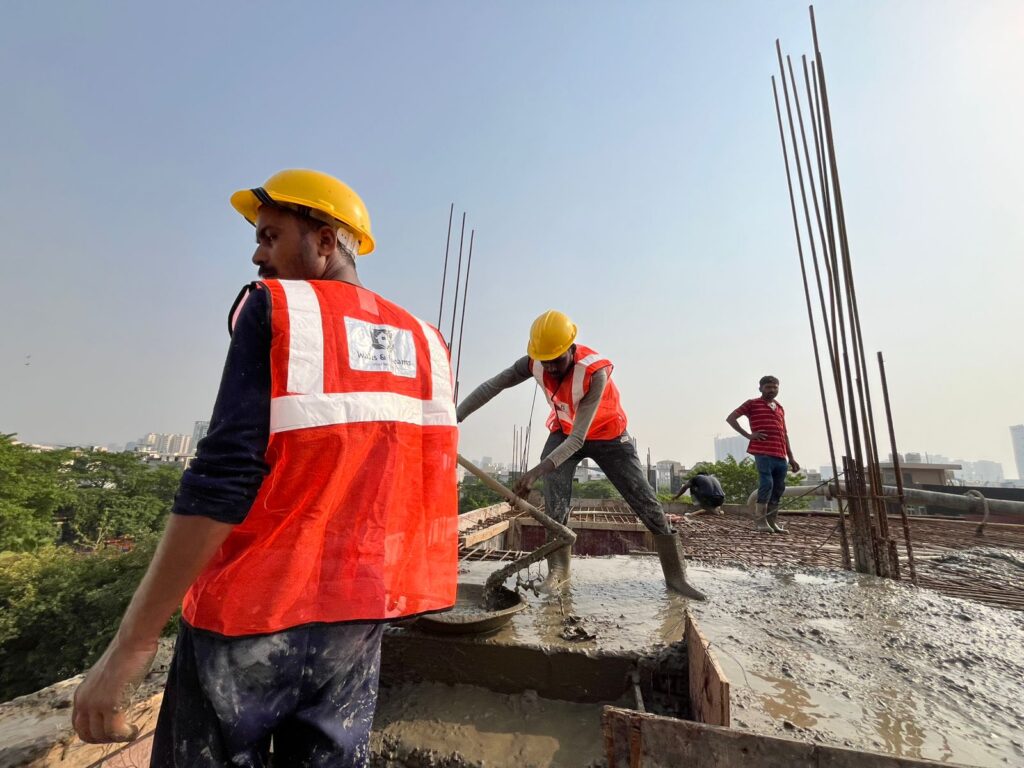
The RCC slab (Reinforced Cement Concrete slab) is one of the most expensive single line items in any building project — and the one homeowners ask us about most often before signing a construction contract. Get the slab right and the rest of the structure follows; get it wrong and you spend the next 30 years dealing with cracks, leaks, and remedial work that costs more than the slab itself did.
This guide walks through what an RCC slab actually costs per square foot in 2026, what each line item in that cost covers, and the on-site decisions that move the number up or down. The figures are drawn from costs we have seen on our own residential projects across Delhi, Noida, Greater Noida, Faridabad, Ghaziabad, and Gurgaon.
Quick answer: A standard residential RCC slab in India typically costs ₹180–₹250 per sq ft, all-in (materials + labour + shuttering). Premium specifications and metro-city projects can push this to ₹300/sq ft or more. The detailed breakdown below explains where each rupee goes.
What Is an RCC Slab?
An RCC (Reinforced Cement Concrete) slab is a composite structural element made of concrete cast around a grid of steel reinforcement bars. The two materials work as a team: concrete handles compressive loads (the weight pushing down on the slab) while the steel handles tensile loads (the bending forces that try to pull the slab apart). Neither material on its own would be enough — concrete is brittle in tension, steel buckles in compression. Cast together, they form one of the most efficient load-bearing systems in modern construction.
RCC slabs are used in:
- Residential buildings (floor slabs, roof slabs, chajjas, lofts)
- Commercial complexes and offices
- Bridges and flyovers
- Industrial and factory floors
- Roof slabs for any structure where a flat, walkable, watertight surface is required
In a typical G+1 or G+2 residential build we deliver, the slab work alone accounts for a meaningful chunk of the structural budget — which is why it pays to understand what’s inside the per-square-foot number before you accept a quote.
RCC Slab Cost Per Square Foot in 2026
For a standard residential RCC slab in India, the all-inclusive cost typically falls between ₹180 and ₹250 per sq ft, covering both labour and materials. In metro cities or for premium specifications — higher-grade steel, higher-grade concrete, additional admixtures, or design-mix concrete instead of nominal mix — the figure can rise to ₹300 per sq ft or more.
Here is a typical line-item cost breakdown for a residential slab in this range:
| Component | Cost Range (Per Sq Ft) |
|---|---|
| Cement | ₹25 – ₹40 |
| Sand | ₹10 – ₹20 |
| Coarse Aggregates | ₹15 – ₹25 |
| Steel Reinforcement | ₹40 – ₹60 |
| Labour | ₹50 – ₹70 |
| Shuttering / Centering | ₹25 – ₹35 |
| Total Estimated Cost | ₹180 – ₹250 |
A note on reading this table: these are not fixed prices — they are the realistic range we see across residential projects in north India. Where your actual cost lands within each range depends on the slab thickness, the steel quantity per square foot (driven by your structural design), the brand of cement and steel specified, and current market rates at the time of casting. For quotes that fall significantly below ₹180/sq ft, ask which line item has been compressed — it is usually steel, shuttering, or labour, and any of the three can compromise the slab.
Cost by slab thickness
Thickness is one of the biggest single drivers of the per-square-foot number. Thicker slabs consume proportionally more concrete and steel:
| Slab thickness | All-in cost (per sq ft) | Typical residential use |
|---|---|---|
| 4 inch (100 mm) | ₹170 – ₹215 | Small spans, lofts, chajjas |
| 5 inch (125 mm) | ₹190 – ₹240 | Most residential floor / roof slabs |
| 6 inch (150 mm) | ₹215 – ₹270 | Long spans, terraces, heavy live loads |
These ranges overlap because thickness is only one input — steel quantity, concrete grade, and current material rates all move the final figure. The right thickness is set by your structural engineer based on spans and loads, not by budget.
Factors Affecting RCC Slab Construction Cost
The headline number hides a lot of variables. These are the six factors that move the cost most on residential projects:
1. Type and Grade of Cement: Different cement brands and grades carry different price tags. The standard slab specification in residential work is OPC 43 or OPC 53 grade. Premium brands such as UltraTech, ACC, Ambuja, and Shree carry a price premium of ₹15–₹30 per bag over economy brands but offer more consistent strength and shorter setting times. PPC (Portland Pozzolana Cement) is also widely used in residential slabs and tends to be slightly cheaper per bag, though it requires longer curing.
2. Steel Reinforcement Quantity: The amount of steel (TMT bars) in the slab depends entirely on the structural design — it is not a quantity you should be guessing or cutting down to save money. Residential slabs typically use less steel per square foot than commercial or load-bearing structures, but the specific quantity needs to come from a qualified structural engineer based on the spans, loads, and configuration of your building. Reducing steel below the design quantity is the single most dangerous form of cost-cutting in slab work.
3. Slab Thickness: Standard RCC slab thickness in residential work ranges from 100 mm to 150 mm (4–6 inches). Thicker slabs consume proportionally more concrete and steel, which raises the per-square-foot cost (see the thickness table above). The right thickness for your project depends on the span between supports, the live load it will carry (terrace, water tank, equipment, etc.), and the structural design — again, a call for the structural engineer, not a place to economise.
4. Location: Construction costs vary noticeably from one city to another, and even between zones within the same city. Material rates and labour wages are higher in Delhi, Mumbai, Bengaluru, and other metros than in tier-2 cities or rural districts. Within the Delhi NCR market itself, our team typically sees a 5–10% difference between Gurgaon and Faridabad on identical specifications, driven mostly by labour and transport.
5. Labour Charges: Slab casting is one of the most labour-intensive operations on a residential site — it requires skilled bar benders for the steel cage, carpenters for the shuttering, a mixer crew, and a vibrator operator, all working to a tight schedule because once the concrete is mixed it cannot wait. Labour rates depend on the region and the complexity of the slab (waffle slabs, post-tensioned slabs, or slabs with heavy projections cost considerably more).
6. Shuttering and Formwork: Temporary structures that hold the wet concrete in place — plywood sheets, steel plates, wooden planks, and the props underneath — represent a substantial slice of the slab cost. Steel shuttering is more expensive upfront but reusable across many slabs and gives a cleaner finish; wooden shuttering is cheaper for one-off pours but produces more wastage and a rougher soffit. The quantity of shuttering needed scales with slab area and the complexity of the geometry.
Materials Used in RCC Slab Construction
A standard residential RCC slab requires the following materials:
- Cement – OPC 43, OPC 53, or PPC depending on specification
- Sand – river sand or M-sand (manufactured sand)
- Coarse Aggregates – 20 mm crushed stone, with 10 mm aggregate sometimes blended in for thinner slabs
- Steel – Fe500 or Fe550 grade TMT bars
- Water – clean and potable; non-potable water can damage both concrete and the rebar over time
- Admixtures (optional) – to improve workability, retard setting time on hot days, or accelerate strength gain
The standard mix ratios are 1:2:4 (M15) for non-structural and lean concrete work, and 1:1.5:3 (M20) for structural slabs in residential construction. Most modern residential slabs now use M20 as the minimum specification because M15 is no longer considered adequate for structural elements under current building codes (IS 456:2000).
Cost by concrete grade
The concrete grade you specify changes the cement content, quality control, and — for M30 and above — whether the mix has to be formally designed rather than batched to a nominal ratio:
| Concrete grade | Nominal mix (cement : sand : aggregate) | All-in slab cost (per sq ft) | Where it’s used |
|---|---|---|---|
| M15 | 1 : 2 : 4 | — (non-structural) | Lean concrete, PCC, levelling — not for structural slabs |
| M20 | 1 : 1.5 : 3 | ₹180 – ₹230 | Standard residential slabs (current minimum) |
| M25 | 1 : 1 : 2 | ₹200 – ₹250 | Longer spans, better durability |
| M30 | Design mix (IS 10262) | ₹230 – ₹290 | Premium / commercial, heavy loads, admixtures |
Per current codes, M20 is the minimum grade for structural slabs. M30 and above are design-mix concrete — proportioned to IS 10262, not to a fixed nominal ratio.
RCC Slab Cost for 1000 Sq Ft
To give you a worked example, taking a moderate rate of ₹220 per sq ft as a midpoint:
Total Cost = 1000 sq ft × ₹220 = ₹2,20,000
This figure covers the slab itself — concrete, steel, shuttering, and labour. Here is what is and isn’t inside that per-square-foot number:
| Included in the per-sq-ft slab cost | Costed separately (not in the slab number) |
|---|---|
| Concrete (cement, sand, aggregate) | Plumbing & electrical conduits laid before the pour |
| Steel reinforcement | Waterproofing of the slab top surface |
| Shuttering / centering | Tiling, flooring, finishing |
| Labour (bar bending, carpentry, pour crew) | Supporting beams & columns |
For a quick sense of budget across common slab sizes:
| Slab area | At ₹190/sq ft | At ₹220/sq ft | At ₹250/sq ft |
|---|---|---|---|
| 500 sq ft | ₹95,000 | ₹1,10,000 | ₹1,25,000 |
| 1,000 sq ft | ₹1,90,000 | ₹2,20,000 | ₹2,50,000 |
| 1,500 sq ft | ₹2,85,000 | ₹3,30,000 | ₹3,75,000 |
| 2,000 sq ft | ₹3,80,000 | ₹4,40,000 | ₹5,00,000 |
These cover the slab only and exclude the items in the right-hand column above. For a complete picture of what your slab will actually cost on your specific plot, the only reliable approach is a detailed BBS (Bar Bending Schedule) and quantity estimate based on your structural drawings.
Tips to Optimise RCC Slab Construction Cost
There are smart ways to reduce slab cost without cutting structural integrity, and there are foolish ones. These are the smart ones:
- Hire a Qualified Structural Engineer. A good structural design optimises the steel quantity to exactly what the slab needs — no more, no less. Over-designed slabs waste steel; under-designed slabs fail. A structural engineer’s fee is a small fraction of what they save you in steel optimisation alone.
- Use Local Materials Where Quality Allows. Sourcing sand, aggregate, and bricks from local suppliers reduces transportation costs significantly. The catch: “local” must still mean “good quality.” Cheap fines-heavy aggregate or silt-heavy sand will cost you more in cement consumption than you save in transport.
- Consider M-Sand Where River Sand Is Scarce. Manufactured sand (M-sand) is now widely accepted in structural concrete and is often cheaper than river sand in regions where river-sand mining is restricted. Most major brands of M-sand meet IS 383 specifications.
- Monitor Material Quality on Delivery. Sub-standard cement, under-weight steel bars, or contaminated aggregate cause cracks, leakage, and remedial costs that dwarf any saving on the original material. Insist on test certificates for steel and cement, and reject deliveries that don’t carry them.
- Buy Cement and Steel in Phased Bulk. Bulk purchase secures better rates, but cement deteriorates after 90 days of storage and steel rusts in monsoon if poorly covered. Order in 2–3 week tranches aligned with your pour schedule rather than dumping all material on site at the start.
Final Thoughts
Understanding what goes into the cost of an RCC slab per square foot helps you budget your construction project properly and ask the right questions when contractors give you a quote. The typical range is ₹180–₹250 per sq ft for residential work, but the figure shifts with location, material quality, slab thickness, and the specific structural design.
Before committing to any slab work, talk to a qualified civil or structural engineer to get a quote tailored to your project. A generic “per square foot” number is a starting point for budgeting — it is not a substitute for a proper structural design and quantity estimate.
How we cost this slab: Our ranges are built bottom-up — current Delhi NCR cement, steel, sand and aggregate rates, plus a standard wastage allowance (roughly 3–5% on concrete, 2–3% on steel), skilled-labour day rates, and shuttering amortised across reuse. Rates are re-checked twice a year against live supplier quotes from our active project sites. The figures here reflect our own residential slab work across Delhi, Noida, Greater Noida, Gurgaon, Faridabad and Ghaziabad.
Standards referenced: IS 456:2000 (Plain & Reinforced Concrete — Code of Practice), IS 10262:2019 (Concrete Mix Proportioning), IS 1786:2008 (High-Strength Deformed Steel Bars — TMT), IS 383:2016 (Coarse & Fine Aggregate). Slab design, steel quantity and grade selection should follow these codes under a qualified structural engineer.
Looking for help planning your RCC slab construction?
Contact us at Walls and Dreams — we can help you with accurate slab cost calculation, structural design coordination, and the on-site quality control that keeps your slab structurally sound for the long run. Our team has delivered residential slab work across Delhi, Noida, Greater Noida, Gurgaon, Faridabad, and Ghaziabad, and we are happy to walk you through a project-specific BBS during the proposal stage.
FAQs on RCC Slab Cost
What is the minimum thickness for an RCC slab?
The standard residential slab thickness is 4–6 inches (100–150 mm), with the exact requirement determined by the spans, loads, and structural design. Slabs thinner than 100 mm are generally not used in residential structural work.
Can you reduce RCC slab cost without losing quality?
Yes — through optimised structural design, careful material sourcing, and minimising wastage. Cost reduction by reducing steel quantity, using sub-standard cement, or skipping curing is not a saving; it shifts the cost to future repairs and structural risk.
Should I use ready-mix concrete (RMC) for slabs?
RMC offers consistent quality and uniformity, making it ideal for larger slabs (typically above 10 m³ in a single pour). It costs slightly more than site-mixed concrete per cubic metre, but saves significantly on labour, shuttering wait time, and the risk of inconsistent batching. For most residential first-floor and roof slabs, RMC is the practical choice.
How long does an RCC slab take to cure?
Proper curing should continue for at least 7 to 14 days after pouring, with 14 days being the safer minimum for structural slabs. Curing is the single most under-respected step in residential slab work — slabs that are not properly cured develop micro-cracks, lose strength, and cause leakage problems for years afterwards.
Does the RCC slab cost include waterproofing?
No. The base slab cost typically does not include waterproofing of the top surface. Waterproofing is a separate line item, costing extra depending on the system used (brush-applied, membrane, integral, or cement-based crystalline). For roof slabs and bathroom slabs, waterproofing is essential and should be budgeted separately from the slab itself.
The price ranges in this article reflect typical residential project costs in north India and are reviewed twice a year. Local market conditions, specific design requirements, and current cement and steel rates can move actual project costs above or below these ranges. For a project-specific quote, please contact our team.
Last reviewed: July 2026 by the Walls and Dreams technical team. Next review: October 2026.