
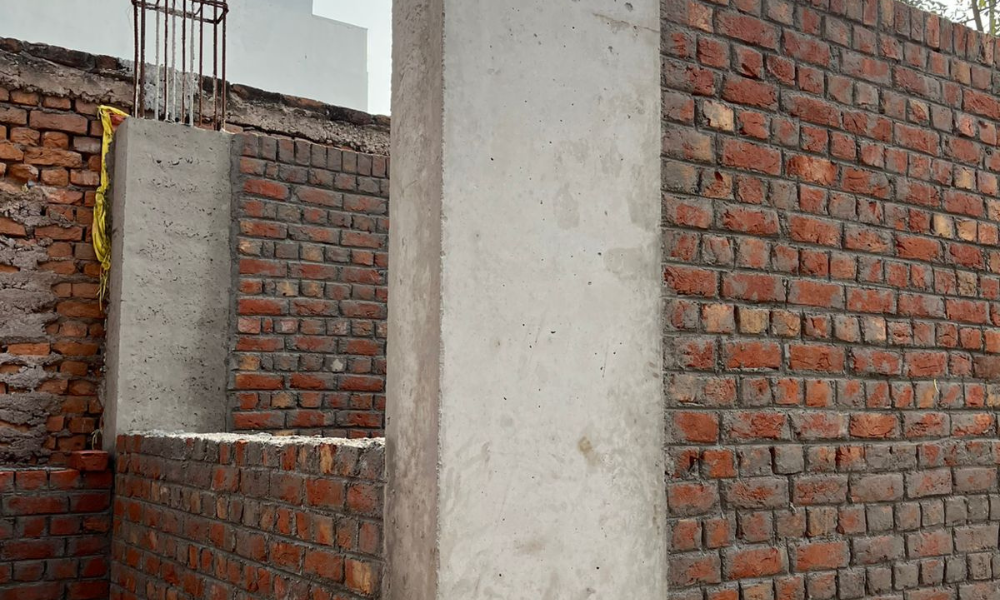
Quick answer: You need approximately 10 bricks per square foot of a 9-inch thick wall, using the standard Indian modular brick (190 × 90 × 90 mm) with a 10–12 mm mortar joint. A 4.5-inch wall needs about 5 bricks per square foot — roughly half. In volume terms, 1 cubic metre of brickwork takes about 500 bricks, plus 1.3 bags of cement and 0.27 m³ of sand for a 1:6 mortar. Add 5–10% for wastage.
Getting the brick count right prevents both mid-project shortages and wasted material sitting on site. Use the calculator below for your exact wall, or read on for the formula, a quick-reference table, and the mortar quantity that goes with the bricks.
Brick calculator
[Brick calculator embeds here — wall size + thickness → bricks, cement, sand]
The correct calculation (worked example)
For 1 square foot of a 9-inch thick wall:
Step 1: Wall (brickwork) volume. A 9-inch wall is 9 ÷ 12 = 0.75 ft thick. Volume = area × thickness = 1 sq ft × 0.75 ft = 0.75 cubic feet.
Step 2: Volume of one brick with mortar. A standard 190 × 90 × 90 mm brick with a ~12 mm mortar joint becomes about 202 × 102 × 102 mm. That’s ≈ 0.0742 cubic feet per brick (with mortar).
Step 3: Number of bricks. Divide the wall volume by the volume of one brick with mortar:
Number of bricks = wall volume ÷ brick-with-mortar volume = 0.75 ÷ 0.0742 ≈ 10 bricks.
So a 9-inch wall needs about 10 bricks per square foot. (The order matters — you divide the wall volume by the brick volume, not the other way round.)

Quick reference: bricks by wall and area
| Wall thickness | Bricks per sq ft | Bricks per 100 sq ft | Bricks per m³ of brickwork |
|---|---|---|---|
| 9 inch (230 mm) | ~10 | ~1,050 | ~500 |
| 4.5 inch (115 mm) | ~5 | ~525 | ~500 |
(Per m³ is the same because it measures brickwork volume, not wall face area. A 9-inch wall simply has more volume per sq ft of face.)
Standard brick sizes
| Brick | Size | With 10 mm mortar |
|---|---|---|
| Modular (IS standard) | 190 × 90 × 90 mm | 200 × 100 × 100 mm |
| Traditional (common) | 230 × 110 × 75 mm | 240 × 120 × 85 mm |
Regional variations exist, so always measure the bricks you’ll actually buy — different sizes change the count.
Mortar quantity (cement + sand)
Bricks need mortar, and most people forget to budget it. For 1 m³ of brickwork with a 1:6 cement-sand mortar (the common ratio for a 9-inch wall):
- Cement: ~1.3 bags (≈63 kg)
- Sand: ~0.27 m³ (≈9.5 cubic feet)
Worked example: 100 sq ft of 9-inch wall: brickwork volume = 100 × 0.75 = 75 cft ≈ 2.12 m³. That needs about 1,050 bricks, 2.6 bags of cement, and 0.55 m³ (~19 cft) of sand — before wastage.
Factors that change the count
- Wastage: add 5–10% for breakage, cutting and handling.
- Openings: subtract the area of doors and windows before calculating.
- Brick type: solid clay, fly-ash, concrete blocks and AAC blocks have different sizes — the ~10/sq ft figure is for standard clay-brick masonry.
- Bond pattern: English or Flemish bond can change the count slightly versus a simple stretcher bond.
Build with quality bricks and correctly mixed mortar — usually a 1:6 ratio for a 9-inch wall — and your masonry stays strong for decades. Planning a full build? See our guide on how much material is required for a 1000 sq ft house, or talk to our team.
Frequently asked questions
How many bricks are needed for 1 sq ft of a 9-inch wall?
About 10 bricks per square foot, using a standard 190 × 90 × 90 mm brick with mortar. A 4.5-inch wall needs about 5.
How many bricks are in 1 cubic metre of brickwork?
Approximately 500 bricks, including the mortar joints, for a standard modular brick.
How many bricks for a 100 sq ft 9-inch wall?
About 1,050 bricks, plus roughly 2.6 bags of cement and 0.55 m³ of sand for the mortar — before adding 5–10% wastage.
How much cement and sand are needed for brickwork?
For a 1:6 mortar, about 1.3 bags of cement and 0.27 m³ of sand per cubic metre of brickwork.
What is the standard brick size in India?
The IS modular standard is 190 × 90 × 90 mm; a common traditional size is 230 × 110 × 75 mm. Regional variations exist.
Should I add wastage to the brick count?
Yes — add 5–10% extra for breakage, cutting and site handling to avoid a mid-project shortage.