
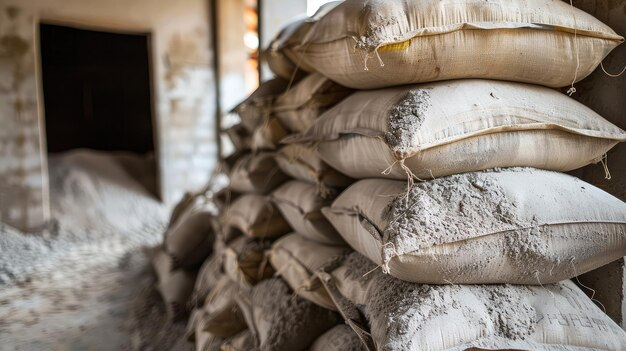
Short answer: If you have a nominal concrete mix of 1:2:4, you will need 6.34 bags (50 kg each) of cement per cubic metre of concrete. That’s what we order in Walls and Dream sites in Noida, Greater Noida and Gurgaon, using the IS 456:2000 dry-volume factor of 1.54 and allowing 2% for site wastage. Here’s how it works, the adjustments we make on site and the errors we see contractors make nearly every week.
Why this is important on site
On a typical 2,500–4,000 sq ft stand-alone house we pour between 80–200 cubic metres of concrete. On a 150 m³ pour, that’s 75 bags you have wasted, not to mention the cost of storage and transport of unused material. But worse, a low estimate means we are halfway through the pour when a runner is dispatched — during which time the concrete turns cold and your structural engineer starts to sweat.
So the number we are about to calculate is not theoretical. It is the number our site engineers put on the bottom of the BBS sheet before we release the indent.
What “1:2:4” means (and why we still use it)
1:2:4 is by volume the proportion of cement to fine aggregate (sand) to coarse aggregate (20 mm down). This is the nominal mix (roughly) equivalent to M15 grade concrete (as per IS 456:2000).
A note from our guys on site: we don’t specify 1:2:4 mix for any structural element of a modern residential building. Slabs, beams, and columns in our G+1 to G+3 builds use M20 or M25 (1:1.5:3 or design mix). 1:2:4 is still used for PCC bedding under footings, levelling courses at the plinth, and infill (non-structural) — so the calculation you see below is what our supervisors use when they are ordering for a footing PCC pour, not for the slab.
If you are being offered 1:2:4, that’s the first thing you should bring up with the contractor, before you talk about cement bags.
The long-form calculation as done on site
We will be determining how much cement is needed for 1 m³ of finished (wet, in place) concrete at a 1:2:4 mix ratio.
Step 1 — Turn wet into dry
When you combine cement, sand and aggregate together and then add water, the final product is smaller. The water fills in the spaces around the aggregate, the sand settles down, and the volume reduces. So to get 1 m³ of concrete placed, you need to mix more than 1 m³ of dry ingredients.
The commonly used multiplier factor in Indian construction practice is 1.54, taking into account the 32–33% voids in coarse aggregate and ~20% in sand. This is the number in line with IS 456:2000 batching and what our QS team uses on all BBS.
Note from our QS team: The original “1/0.67 ≈ 1.50” calculation you see on many of the cost guide blogs is low. We have done trial mixes on our sites in Sector 150 Noida with Yamuna sand and Bharatpur stone aggregate, 1.54 is much closer to actual mix consumption. We use 1.50 only for design mixes with washed graded aggregate — which most residential sites aren’t getting from the local supplier.
So: Dry volume = 1 m³ × 1.54 = 1.54 m³
Step 2 — Add a wastage percentage
Cement is wasted due to spillage on the mixer, cement remaining in the bags, mortar remaining in the chute, and trial cubes. On a well-managed site we allow 2%. At a site with a new mixer operator, or poor handling, we budget 5%.
- Total dry volume (with 2% wastage) = 1.54 × 1.02 = 1.5708 m³
Step 3 — Break down the cement in the mix ratio
In a 1:2:4 mix, the total parts add up to 1 + 2 + 4 = 7, and cement is 1 of those 7 parts.
- Cement volume = 1.5708 × (1 / 7) = 0.2244 m³
Step 4 — Convert to weight, then convert to bags
The bulk density of loose dry cement is around 1,440 kg/m³ (this is the standard value; it will vary a little between brands and freshness — we have measured from 1,400 to 1,460 kg/m³ in bags from the same supplier in different weeks).
- Weight of cement = 0.2244 × 1,440 = 323.1 kg
- Number of 50 kg bags = 323.1 / 50 = 6.46 bags
So why did we say 6.34 bags above?
Because you can apply the wastage in two places: at the dry volume (which increases the volume of everything) or just cement. Either way is OK, we use this because wastage is not only due to cement. Other engineers like a more specific 6.25–6.34 bags/m³, based on 1.52 dry volume + 2% wastage on cement only.
The truth is: buy 6.5 bags per m³ of 1:2:4 PCC, round up for the project, and you will not go wrong. That is what we do.
Table of cement bags per 1 m³ for nominal mixes
The following numbers are all based on dry volume factor of 1.54, 2% wastage, 50 kg bags at 1,440 kg/m³ density. This is what our site engineers have written down from the printout of the estimate that hangs in our office.
| Mix ratio | Typical use | Cement (m³) | Cement (kg) | Bags (50 kg) |
|---|---|---|---|---|
| 1:1.5:3 (M20) | Slabs, beams, columns in residential | 0.2802 | 403 | 8.07 |
| 1:2:3 | Large footings, retaining walls | 0.2618 | 377 | 7.54 |
| 1:2:4 (M15) | PCC bedding, plinth levelling, non-structural | 0.2244 | 323 | 6.46 |
| 1:3:6 (M10) | Mass concrete, sub-base | 0.1571 | 226 | 4.52 |
| 1:4:8 (M7.5) | Lean concrete under footings | 0.1178 | 170 | 3.39 |
Correction: Many cost-guides published online (including a previous version of this article) calculate the 1:2:3 mix without using the 1.54 dry-volume adjustment factor and come up with “5 bags per m³”. That’s 50% too low. It should be ~7.5 bags per m³. If your supplier/contractor tells you 5, you will be short 2nd load of mortar.
Cement for 1m³ of brickwork (1:6 mortar)
The dry volume factor for brickwork mortar is different to concrete because there is no coarse aggregate to produce large voids; there’s just sand. The dry-volume factor for mortar is 1.33, not 1.54.
The volume of mortar needed for 1 m³ brickwork is not 1 m³. 230 × 110 × 75 mm bricks laid with 10 mm joints are approximately 70% brick, 30% mortar by volume — so 1 m³ of brickwork will contain 0.30 m³ of wet mortar.
For 1 m³ of brickwork:
- Wet mortar volume = 0.30 m³
- Dry mortar volume = 0.30 × 1.33 = 0.399 m³
- With 2% wastage = 0.407 m³
- Cement portion (1 of 7 parts) = 0.407 / 7 = 0.0581 m³
- Weight = 0.0581 × 1,440 = 83.7 kg
- Bags = 1.67 bags per m³ of brickwork
This is significantly different to what a lot of cost guides calculate (“4.2 bags”) because they don’t realise 1 m³ of brickwork is not 1 m³ of mortar. This would be correct if you were to fill an empty 1 m³ trench with pure mortar — but you never do that.
Field note: For our recent Greater Noida West villa project we used 14,200 modular bricks for the boundary wall and superstructure. We estimated 1.67 bags per m³ of brickwork and ~28 m³ of brickwork, so we ordered 50 bags. Actual consumption was 48. This is the accuracy you get with the correct dry-volume factor.
How many bricks in 1m³ (with mortar)?
For standard Indian modular bricks (190 × 90 × 90 mm with 10 mm mortar joint), the laid size is 200 × 100 × 100 mm.
- Volume per laid brick = 0.2 × 0.1 × 0.1 = 0.002 m³
- Bricks per m³ of brickwork = 1 / 0.002 = 500 bricks
For traditional/non-modular bricks (230 × 110 × 75 mm with 10 mm joint), laid size is 240 × 120 × 85 mm:
- Volume per laid brick = 0.002448 m³
- No. of bricks per m³ of brickwork = 408 bricks
Don’t forget to double check with your supplier what type of brick they are delivering — we’ve had two different types delivered to the same site and the only way to spot the difference is to measure 10 bricks per pallet before they are stacked.

The factors that affect cement consumption on-site
The textbook formula is a baseline number. These are the real-life variables that increase or decrease the cement consumption — and we have experienced all of them on our sites:
1. Sand bulking: Sand from a covered yard is wet, and increases in volume 20–30% compared to dry sand. If you measure volume without measuring moisture, you use less sand and your cement:fines ratio changes. We test bulking (fill a bucket, wet, measure the shrinkage) of every new sand delivery in the monsoon.
2. Grading and shape: Angular aggregate has more voids than river gravel with rounded shape. Poor grading with an excess of fines will require more cement to cover the surfaces. We reject lots with more than 10% passing the 10 mm sieve (20 mm aggregate).
3. Water-cement ratio drift: If a site mason adds “just a bit more water” to make the mix easier to work, he is reducing the strength (and making it tempting for site engineers to “over-cement”). The right answer is to address the workability issue (better aggregate, add an admixture) rather than over-cement.
4. Bags don’t always weigh 50 kg: We have weighed bags from the big Indian brands (UltraTech, ACC, Ambuja, Shree, JK) and most are 49.4–50.2 kg. Fake and re-bagged cement, which is a serious problem in some places, can be as low as 47 kg. On a 200-bag pour, that’s 600 kg of cement missing.
5. Storage losses: Cement bags over 90 days old weaken. If cement bags are stored on a wet floor or up against a wall they can pick up moisture. We only order 2 weeks of cement at a time on any site for this reason.
What we do on Walls and Dreams sites
Here are a couple of the things we do as part of our QA but most residential contractors do not:
- Cube tests on every major pour: We make 6 cubes for each slab and test 7 and 28 days in a NABL-accredited lab. We find out whether we got the design strength with the cement we used — not if we counted bags correctly.
- Bag weights on delivery: A 100 kg hanging digital scale on site is paid for by the first time you catch a short bag.
- Site-mix vs. RMC decision tree: For pours < 10 m³ we site-mix. For pours over ~10 m³ we use RMC from a batching plant where the m³ we order is the m³ we receive, and we leave the dry-volume calculation to the supplier. For the majority of slab pours in residential construction this is in the region of the first-floor slab.
- Real-time consumption logging: Site engineer records cement bags used vs. m³ poured every day. We investigate any difference of more than 5% between the running ratio and the calculated value to ensure it isn’t a structural problem.
The importance of an accurate estimate in your bottom line
Cement is usually the largest line item in your structural materials budget. Ordering 10% more cement than you need is not a 10% waste on cement, but a significant percentage of your contingency being wasted on cement bags.
You can determine the number of bags you need. There is no reason to guess.
Need an estimate for your project? The cost estimator will work out your cement, steel, and material requirements, based on your floor area and height. For detailed projects, contact one of our project engineers — we will do a BBS for you, free of charge, in the proposal phase.
Where we got the numbers in this article
The calculations above use the dry-volume factor of 1.54 cited in IS 456:2000 batching practice for nominal mixes, the cement bulk density of 1,440 kg/m³ (standard for OPC) and a 2% site wastage percentage based on our own consumption data from around 40 residential projects in Delhi NCR over the last four years. The 1:6 mortar calculation uses the 1.33 dry-volume factor for masonry mortar, which is the figure used by most Indian quantity surveyors and is in line with the CPWD’s calculations in their analysis-of-rates reports.
For the details of how we calculate all the costs and quantities on this website, including the site-wastage percentages, sand-bulking adjustments and bag-weight allowances.
Frequently asked questions
How many bags of cement for 1m³ of M20 concrete (1:1.5:3)?
About 8 bags (50 kg) of cement per cubic metre (dry volume 1.54 and 2% wastage). M20 is the residential concrete grade commonly used in India.
How many bags of cement in 1m³ of M15 (1:2:4) concrete?
Around 6.5 bags (50 kg) per m³. M15 can be used for plain concrete cement (PCC) and non-structural elements, but not for slabs and columns for today’s residential construction.
Why is my contractor’s quote different to this?
Because of one of these three reasons:
- They are using a different dry volume factor (1.50, 1.52 or 1.57),
- They are using a different wastage factor (2–5% is common), or (
- They are estimating a different mix ratio than the one you’ve specified.
Ask them to show you the calculation — they should.
Is this formula for ready-mix concrete (RMC)?
No — when you buy RMC by the cubic metre, the conversion from dry to wet is done by the supplier at the concrete plant. The concrete is sold as will be delivered, not as dried materials. This is only for concrete that is mixed on site.
What if I am using 43-grade cement vs 53-grade cement?
The number of bags is the same, but the strength and water requirements are different. 53-grade will provide faster early strength but is more critical of water-cement ratio. 43-grade OPC or PPC is suitable for most residential structural concrete in our environment.
Reviewed: April 2026 by the Walls and Dreams technical team. Next review: October 2026.