
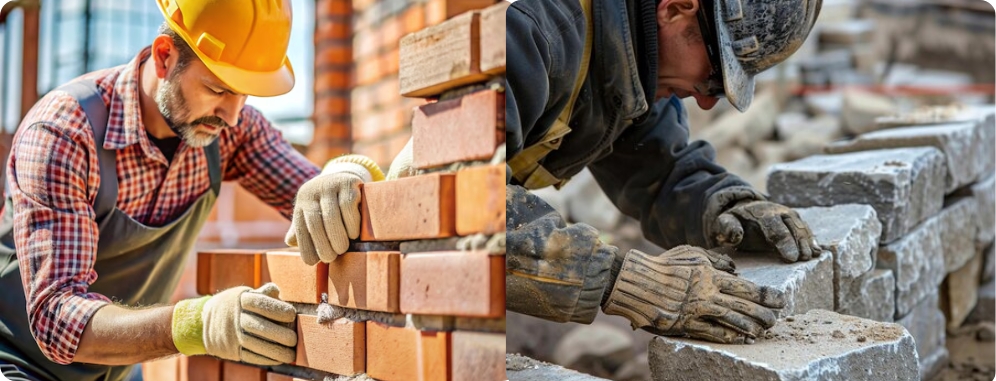
Quick answer: Stone masonry uses natural stone such as granite, sandstone or limestone set in mortar. It is stronger, heavier and lasts longer, but costs more and needs skilled masons. Brick masonry uses uniform clay bricks, so it is cheaper, lighter and faster to build and easier to alter. Most houses use brick; stone suits foundations, retaining walls and premium elevations.
Masonry is the building of walls and other parts of a structure by laying individual units, such as bricks, stones or concrete blocks, in mortar. The unit you choose decides the weight of the wall, the foundation it needs, the skill required on site and the cost. Besides stone and brick there is also concrete block masonry and glass block masonry; this guide compares only the first two.
Stone masonry vs brick masonry at a glance
| Aspect | Stone masonry | Brick masonry |
| Material | Natural stone from quarries | Bricks made from clay, readily available |
| Appearance | Many natural colours and textures; usually left exposed | Typically red; usually plastered, sometimes left exposed |
| Strength and weight | Stronger units but a heavier wall with a higher dead load; irregular shapes make bonding harder | Uniform bricks bond easily; lighter wall with a lower dead load |
| Durability | Higher longevity | Fairly durable with a moderate lifespan |
| Cost of construction | More costly | More economical |
| Handling | Difficult; stones are heavy and need dressing | Simple; a mason lifts a brick in one hand |
| Changes later | Hard to cut openings or alter | Easy to chase, cut and extend |
| Skill needed | Skilled stone masons | Any trained mason |
What is stone masonry?
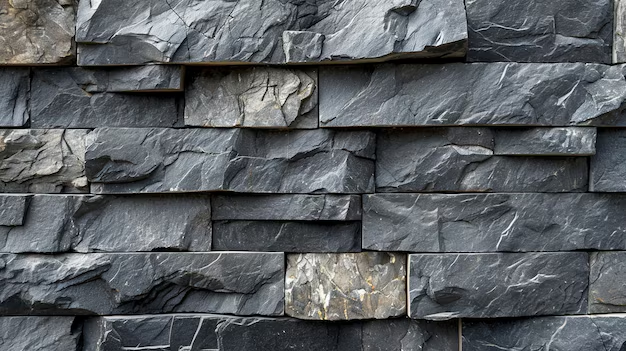
Stone masonry is construction with natural stone, such as limestone, sandstone, marble or granite, shaped and fitted together with mortar. It is used where strength and durability matter most: foundations, floors, walls and retaining walls. It can carry the load of the building or be used as a facing on the outside of another wall.
Types of stone masonry
- Rubble masonry: stones are used close to their natural shape, with wider mortar joints. It is the least expensive kind of stonework and is common in foundations, boundary walls and retaining walls.
- Square rubble masonry: the faces and corners of the stones are roughly squared so that they sit in more regular courses.
- Ashlar masonry: accurately dressed stones laid with thin, even joints. It gives a formal finish, needs skilled work and is the most costly.
What is brick masonry?

Brick masonry is the laying of bricks in mortar, in a regular pattern, to form a wall. Because bricks are made to one size, the work is quick and the wall thickness is predictable. There are several types of bricks with different properties, which makes brick masonry suitable for residential, commercial and decorative work.
Types of brick masonry
- Brickwork in mud mortar: mud is used in place of cement mortar. It is cheap and is found in low, temporary or rural structures. It is not suitable for the walls of a modern house.
- Brickwork in cement mortar: the standard for houses. Cement mortar gives much higher strength and durability.
The pattern in which bricks are laid is called the bond. See the types of brick bonds for how each one looks and where it is used.
What are the advantages and disadvantages of stone masonry?
Advantages
- Very strong and long-lasting. Well-built stone walls stand for generations.
- Stands up well to rain, sun and wear, so it needs little protection on the outside.
- Attractive in its natural form. No plaster or paint is needed.
- Thick stone walls take time to heat up and cool down, which keeps rooms more comfortable.
Disadvantages
- Higher cost of labour and of good-quality stone.
- Heavy. The walls are thicker and need a wider, stronger foundation.
- Slow to build, and difficult to alter after the structure is up.
- Needs skilled stone masons, who are harder to find than brick masons.
What are the advantages and disadvantages of brick masonry?
Advantages
- Bricks are available almost everywhere and are cheap.
- All bricks are the same size, so the work follows a repeating pattern and goes up quickly.
- Walls are thinner and lighter, which saves floor space and reduces the load on the foundation.
- Easy to cut for door and window openings, electrical conduits and plumbing lines.
- Takes plaster, paint and cladding well, and can also be left exposed.
- Good fire resistance, because bricks are already burnt in a kiln.
Disadvantages
- Less strong and less durable than good stonework.
- Bricks absorb water. Without plaster, a damp-proof course and good drainage, the wall can turn damp, show white salt deposits and crack.
- A plain brick wall does not have the look of natural stone.
- Quality varies a lot between kilns, so bricks have to be checked on delivery.
Which is better for a house?
For the walls of a typical house, brick is the practical choice. It is cheaper, lighter, faster and easier for every trade that follows the mason. Modern houses in most cities are also built as an RCC frame, where columns and beams carry the load and the walls only fill the gaps between them; a lighter wall is an advantage there.
Stone makes sense in these cases:
- Foundations and plinths in areas where stone is the local material.
- Retaining walls and boundary walls, where weight is useful and the wall is exposed to weather.
- Front elevations and feature walls, as solid stone or as stone cladding over a brick wall.
- Hill regions, where stone is quarried nearby and bricks have to be transported.
Many houses combine the two: brick walls for the structure, with stone on the plinth, gate pillars or part of the front. If you are comparing brick with other walling units, see brick vs cement blocks in masonry.
What should you check on site?
For stonework
- Stones should be hard and sound, without cracks or soft, flaky layers.
- Long stones should run through the thickness of the wall at intervals to tie the two faces together.
- Gaps between large stones must be packed with small stone pieces and mortar, not left hollow.
- Vertical joints should not line up from one course to the next.
For brickwork
- Bricks should be evenly burnt, of the same size and give a clear ringing sound when two are struck together.
- Bricks should be soaked in water before laying so that they do not pull water out of the mortar.
- Courses should be level, the wall plumb, and vertical joints staggered.
- Mortar should fill every joint fully. See the brick mortar ratio guide for the mix.
- New brickwork has to be kept wet for several days so that the mortar gains strength.
Summary
Stone masonry gives the stronger, longer-lasting and better-looking wall, at a higher cost and with more labour. Brick masonry is affordable, uniform and easy to work with, which is why it is used for most buildings. The right choice depends on what the wall has to do, the look you want, the stone and bricks available locally, and the budget. For the finishing of either wall, read the difference between plastering and pointing. Walls and Dreams builds homes across Delhi NCR; our construction company page explains how we work.
FAQs
What is the main difference between stone masonry and brick masonry?
Stone masonry uses natural stone of varying size, dressed and fitted on site. Brick masonry uses clay bricks of one uniform size. Stone gives a stronger, heavier and longer-lasting wall. Brick gives a lighter, cheaper wall that is quicker to build and easier to alter.
Which is stronger, stone masonry or brick masonry?
Stone is the stronger and more durable material. A stone wall is also much heavier, so it needs a wider foundation. In a house with an RCC frame, the columns and beams carry the load, so the extra strength of stone walls is rarely needed.
Which is cheaper, brick or stone masonry?
Brick masonry is more economical. Bricks are cheap and widely available, and any trained mason can lay them quickly. Stone masonry costs more because of the price of good stone, the dressing work and the skilled labour it needs.
Where is stone masonry used in a house?
Stone masonry is used for foundations, floors, walls and retaining walls. In houses today it is most common in foundations and plinths, boundary and retaining walls, and as a facing or cladding on the front elevation.
What are the types of stone masonry?
The main types are rubble masonry, which uses stones close to their natural shape; square rubble masonry, where faces and corners are roughly squared; and ashlar masonry, which uses accurately dressed stones with thin joints and is the most costly.
Does a brick wall need plaster?
Not always, but bricks absorb water, so an unplastered wall needs good-quality bricks, full mortar joints and protection from damp. Most house walls are plastered. Stone walls are usually left exposed with the joints pointed.