
The south-east direction — known in Vastu Shastra as Agneya — is associated with the element of fire (Agni), and is one of the most discussed directions in residential plot selection. Many families come to us with questions about south-east corner plots specifically: are they auspicious, what restrictions apply, and how to plan a home that honours both the principles of Vastu and the practical realities of construction.
This guide walks through the traditional Vastu Shastra view on south-east corner plots — what they are considered suited for, the room placements traditionally recommended, the entrance and toilet rules, the pros and cons, and the remedies suggested for situations where ideal placement isn’t possible. The content reflects mainstream Vastu practice as commonly cited in Indian residential design.
A note before you read: The recommendations below are drawn from traditional Vastu Shastra. They are not absolute rules, and any major design or construction decision should also account for practical considerations like sun path, ventilation, plot dimensions, and statutory requirements. For your specific plot, consult a qualified Vastu practitioner alongside your architect.
Understanding the South East Corner Plot
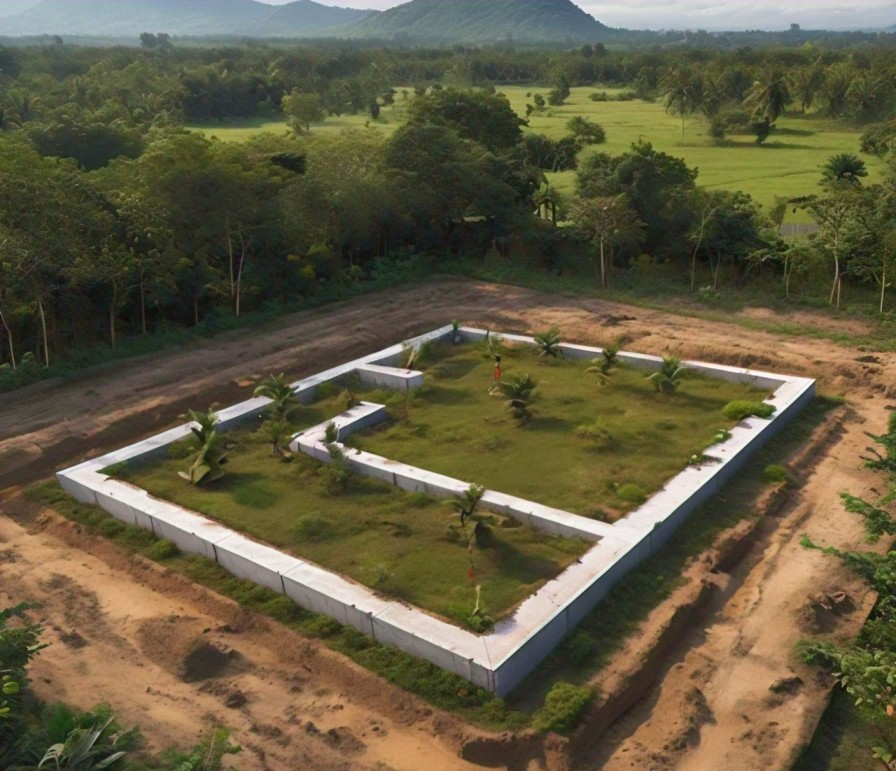
A south-east corner plot is a plot that has roads on both its eastern and southern sides — meaning the plot sits at the intersection of the east-running road and the south-running road, with the south-east as its outer corner.
In Vastu tradition, these plots are considered well-suited for businesses that involve fire, energy, or transactional activity — restaurants, cafés, tea stalls, bakeries, and small industries dealing with electricity, machinery, or fireworks. For residential use, south-east corner plots are workable but require careful planning, because the fire element governing this direction can become destabilising if the home’s layout isn’t aligned with traditional principles.
A few traditional rules for selecting a south-east corner plot for a home:
- Plot shape: Square or rectangular plots are preferred. Triangular or irregular plots in this direction are traditionally avoided.
- Plot proportions: The frontage should be wider than the rear, with the plot tapering slightly toward the back rather than expanding.
- Plot levels: The traditional preference is for the south-west to sit higher than the north-east, with the lowest point of the plot at the north-east corner — the direction associated with water.
These principles set the energetic foundation for the home that will be built on the plot. The room-by-room placements that follow are layered on top of this foundation.
Entrance Direction for South East Corner Plots
The placement of the main entrance (mukhya dwar) is one of the most important Vastu decisions in any home, and it carries particular weight on a south-east corner plot.
Traditional Vastu practice recommends:
- Preferred entrance direction: East or North-East, even on a south-east corner plot. The east-facing entrance is associated with prosperity, opportunity, and the energy of the rising sun.
- Avoid if possible: South-east entrance: While it may seem logical to enter from the corner of a south-east plot, traditional Vastu considers this direction less favourable for a residential entrance because the fire element governing the south-east can create instability when energetically tied to the daily entry point of the home.
If the layout of the plot or road access leaves no choice but a south-east entrance, the traditional remedy involves placing three Vastu pyramids at the main door to mitigate the unfavourable energy. A qualified Vastu practitioner can also suggest specific doorway adjustments, threshold treatments, or symbolic placements to balance the energy at the entrance.
Kitchen Placement in South East Corner Vastu
This is the room placement where Vastu and the south-east direction align most clearly.
The kitchen is traditionally placed in the south-east corner of the home. The reasoning is direct: the kitchen is governed by Agni (fire), and the south-east is the direction governed by Agni. Placing the kitchen here aligns the room’s natural energy with the direction’s natural energy.
Traditional kitchen rules to follow:
- Cook facing east or west: The cook should ideally face east while preparing meals, with west as a secondary option. Avoid cooking facing north or south.
- Window placement: Windows in the kitchen should open to the north-east or north-west to allow good ventilation while preserving the energetic balance of the room.
- Avoid kitchen in south-west: This is one of the strongest traditional prohibitions. The south-west is the direction of stability and the master bedroom — placing the fire-element kitchen here is considered to disturb both the kitchen and the bedroom.
For a south-east corner plot specifically, the kitchen placement in the south-east of the building is one of the easiest Vastu alignments to achieve.
Bedrooms and Living Room Placement
Room placement in a south-east corner home follows broader Vastu principles:
- Master bedroom: South-west corner. The south-west is associated with stability, weight, and authority — qualities suited to the head of the household. The master bedroom in the south-west is one of the most consistent recommendations in Vastu.
- Guest bedroom: North-west corner. The north-west, governed by Vayu (air), is associated with movement and transitions — making it suitable for guests, who are temporary occupants.
- Living room: North or East. The northern and eastern directions invite morning and afternoon light and are associated with social energy, harmony, and openness.
Avoid bedrooms in the south-east. For a home with a south-east entrance, traditional Vastu specifically advises against placing bedrooms in the south-east, as the fire element of this direction is considered unsuitable for sleep and rest.
Toilets, Bathrooms, and Septic Tank Placement
Toilet and bathroom placement is one of the most carefully governed areas in Vastu Shastra, with several “do not” rules that apply universally — not just to south-east corner plots.
Recommended placement:
Toilets are best located in the west or north-west quadrant of the home
Traditional prohibitions:
- Avoid toilets in the south, north, or south-west.
- Avoid toilets in the centre of the home (Brahmasthan) — this is the energetic heart of the building and should be left clear.
- Avoid toilets directly under a staircase — the location is considered to create energy bottlenecks.
- Avoid septic tanks in the north-east or south-west. The north-east is the direction of water and purity; the south-west is the direction of stability — neither should be associated with waste storage.
These rules apply in addition to whatever direction-specific rules govern the rest of the layout.
Pros and Cons of South East Corner Plots
Like any plot orientation, south-east corner plots come with both advantages and challenges.
Advantages
- Excellent natural light — the southern and eastern exposures together give long sunlight hours throughout the day, reducing daytime artificial lighting needs.
- Strong gardening conditions — the southern light supports a wider variety of flowering and fruit-bearing plants in the garden.
- Beneficial in cooler regions — for plots in northern hill stations or cooler climates, the additional sunlight is a significant practical benefit.
Disadvantages
- Heat gain in summer — in hot regions like much of north India, the same sunlight that warms a winter home creates summer cooling loads. Air-conditioning costs can run higher than for north-facing plots if the design doesn’t account for solar shading.
- Higher Vastu sensitivity — homes on south-east corner plots are traditionally more sensitive to Vastu errors. A poorly designed south-east home can compound issues that a north-east home would absorb without difficulty.
- Restrictions on water features — traditional Vastu prohibits placing borewells or underground water tanks in the south-east, since water in the fire-dominated zone is considered to create energetic conflict.
- Resale perception — fair or not, some buyers carry preconceptions about south-facing homes, which can affect the resale market. A well-designed and Vastu-compliant home addresses this objection in person, but the perception can affect the initial pool of interested buyers.

South East Corner Vastu Remedies
If your home has Vastu challenges that can’t be addressed structurally, traditional practice offers several remedies:
- Mirror placement: Mirrors are widely used in Vastu remedies. For a south-east corner that is causing concern, hanging a mirror on the south-west wall is traditionally said to reflect and redistribute the energy.
- Vastu pyramids at the main entrance: For homes where the main entrance is in the south-east (rather than the preferred east or north-east), placing three Vastu pyramids at the front door is the most commonly cited remedy.
- Wall colours: Traditional Vastu suggests painting the south-east walls in deeper, fire-aligned tones — crimson, terracotta, or warm earth tones — to harmonise the room with the direction’s natural element.
- Vastu Kalash: Placing a Vastu Kalash (a sacred pot, traditionally filled with water and decorated) in the south-east corner is said to attract harmony and prosperity to the household.
- Sea salt or camphor crystals: For master bedrooms that are unavoidably in the south-east direction, placing a small dish of sea salt or camphor crystals in the corner — facing north-east — is a traditional remedy for absorbing imbalanced energy.
- Plants: Specific plants are traditionally recommended for the south-east direction: money plant, jade plant, and bamboo plant. These plants are associated with prosperity and are considered compatible with the fire element.
These remedies are most effective when applied as a coherent set rather than in isolation, and ideally with the guidance of a qualified Vastu practitioner familiar with your specific plot and family.
Can the South East Corner Be Extended?
Generally, no. Extending or expanding the south-east corner of a building is one of the strongest traditional prohibitions in Vastu Shastra.
Because the south-east is governed by Agni (fire), an extension in this direction is believed to “stretch” the fire element into spaces where it shouldn’t dominate, creating energetic imbalance. Traditional Vastu associates south-east extensions with three categories of concern:
- Financial challenges — unexpected expenses, business setbacks, or instability in income flow
- Health concerns — particularly issues related to metabolism, fertility, or general energy levels
- Increased family stress — frequent disagreements, restlessness, or conflict among occupants
If a structural or architectural reason makes extension in this direction unavoidable, the traditional response is to:
- Consult a qualified Vastu practitioner before finalising the design
- Accompany the extension with specific remedies (placement of symbolic items, mirrors, or pyramids)
- Balance the extension with corresponding extensions or design weight in compatible directions
For most residential projects, extensions in the north-east or east are far better-received in Vastu tradition than south-east extensions.
A Practical Note from Our Architecture Team
While this article focuses on traditional Vastu principles, the practical side of building on a south-east corner plot deserves a separate mention.
In our experience delivering residential projects across Delhi, Noida, Greater Noida, Gurgaon, Faridabad, and Ghaziabad, south-east corner plots offer real architectural opportunities — generous natural light, two open road frontages, and good visibility — but they need careful design to manage the heat gain that comes with extended southern exposure. A few practical points:
- Solar shading matters: Deep chajjas (overhangs) above south and west-facing windows, vertical fins on west walls, and well-placed verandahs can reduce summer cooling loads by a meaningful margin.
- Plan the kitchen placement at design stage: Aligning the kitchen with the south-east (which Vastu also prefers) is one of the easier two-birds-one-stone wins. The kitchen ventilation can be designed to extract heat outward, supporting both the Vastu principle and the building’s thermal performance.
- Two road frontages need careful boundary planning: Setbacks, parking access, and the main entrance all need to be planned considering both road directions and any local building byelaws — Noida, Gurgaon, Greater Noida and Delhi each have specific corner-plot rules.
- Vastu and structural design can usually coexist: The tension between traditional placement and structural efficiency is rarely as sharp as it seems; most homes can be designed to honour both.
Our architects regularly work alongside Vastu consultants on residential projects. If you are planning to build on a south-east corner plot and want help balancing traditional considerations with the practical and statutory realities of construction, contact our team — we can walk through your specific plot and family situation.
Conclusion
A south-east corner plot, governed by Agni and rich in natural light, is a workable plot for a residential home — provided the design respects the traditional Vastu principles that have governed Indian residential planning for centuries. The key choices are clear: keep the main entrance in the east or north-east where possible, place the kitchen in the south-east, the master bedroom in the south-west, toilets in the west or north-west, and avoid extending the south-east corner.
For situations where ideal placement isn’t possible, Vastu offers a range of remedies — pyramids, mirrors, colour treatments, plants, and sacred placements — that can balance an imperfect layout when applied thoughtfully.
A well-designed home on a south-east corner plot is fully capable of bringing the prosperity, stability, and harmony that traditional Vastu envisions for its occupants. The first step is to plan the home with both a qualified architect and a qualified Vastu practitioner, ideally before the foundation is laid.
If you are planning to build on a south-east corner plot in Delhi NCR, our team at Walls and Dreams is happy to help you balance Vastu principles, architectural design, and practical construction — across all stages from plot evaluation to project handover.
Frequently Asked Questions
Is a south-east corner plot good for a residential house?
According to Vastu Shastra, south-east corner plots are workable for residential use but require careful planning. The fire element (Agni) governing this direction can become destabilising if the home’s layout isn’t aligned with traditional principles. With the right placement of entrance, kitchen, bedrooms, and bathrooms — and a thoughtful approach to the design — south-east corner plots can be made to support prosperity and harmony for the occupants.
Which direction should the main entrance face on a south-east corner plot?
Traditional Vastu recommends the main entrance to face east or north-east, even on a south-east corner plot. South-east entrances are traditionally avoided for residential use because the fire element governing this direction can create instability when tied to the daily entry point of the home. If a south-east entrance is unavoidable, placing three Vastu pyramids at the main door is the most commonly cited remedy.
Where should the kitchen be placed in a south-east corner home?
The south-east corner of the home — the kitchen and the south-east direction are both governed by Agni (fire), making this one of the strongest Vastu alignments. The cook should ideally face east while preparing meals, with windows opening to the north-east or north-west for good ventilation. Avoid placing the kitchen in the south-west, which is one of the strongest traditional prohibitions.
Where should the master bedroom be in a south-east corner home?
The master bedroom should be placed in the south-west corner of the home. The south-west is associated with stability, weight, and authority — qualities suited to the head of the household. This is one of the most consistent recommendations across Vastu traditions. Bedrooms should generally not be placed in the south-east, as the fire element of this direction is considered unsuitable for sleep and rest.
Where should toilets and septic tanks be located in a south-east corner home?
Toilets are traditionally best placed in the west or north-west quadrant of the home. Avoid toilets in the south, north, south-west, or in the centre of the home (Brahmasthan). Septic tanks should not be placed in the north-east (the direction of water and purity) or south-west (the direction of stability) — neither should be associated with waste storage.
This article presents traditional Vastu Shastra perspectives on south-east corner plots. Specific recommendations for your plot and family should be confirmed with a qualified Vastu practitioner alongside your architect.
Last reviewed: April 2026 by the Walls and Dreams editorial team. Next review: October 2026.