
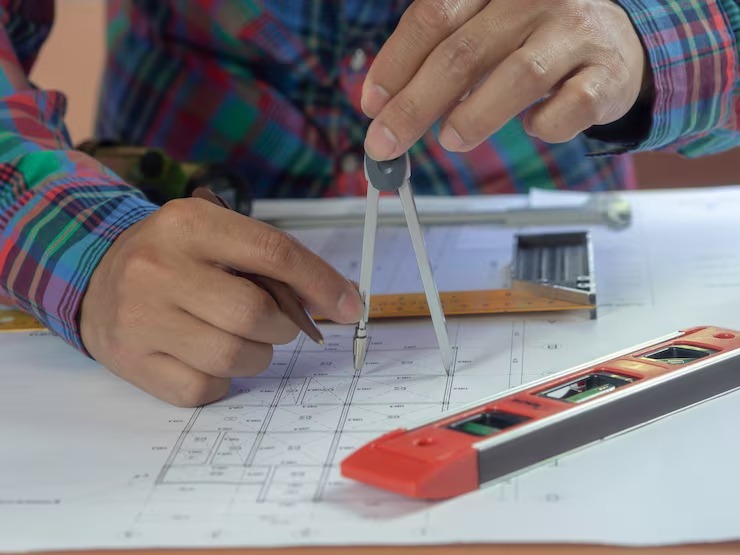
In today’s construction, the structural integrity starts below the ground level. A well-designed foundation ensures that every architectural vision stands strong for the decades to come. Among the many types of foundation systems employed in both residential and commercial construction projects, eccentric footing design plays an important role when the structural loads are not centrally located.
At Walls and Dreams, we believe that great design is not just about aesthetics – its about stability, safety and smart engineering. In this complete guide, we’ll examine the types, principles, methods of reinforcement, and structural stability considerations of eccentric footings
What is Eccentric Footing?
An eccentric footing is the type of foundation in which the column load does not act at the center of the base of the footing. Instead the load is offset resulting in an eccentricity which produces additional bending moments.
This situation usually occurs when:
- A column is placed near a property boundary
- Architectural constraints limit footing symmetry
- Structural loads are uneven
- Renovation or extension projects require adjustments
In such cases, an eccentric column footing will become of great importance which will allow it to safely transfer the load to the soil without causing excessive settlement or instability.
Why Eccentric Footing Design is Important
When loads are centrally applied, soil pressure remains uniform. However, in eccentric footing design, the off-center load creates:
- Uneven soil pressure distribution
- Increased bending moments
- Risk of footing rotation
- Potential structural cracks
Proper design ensures that:
- Maximum soil pressure remains within safe bearing capacity
- Tensile stresses are properly reinforced
- Structural stability is maintained under service loads
Without correct calculations and detailing, an eccentric footing can compromise the entire structure.
Types of Eccentric Footing
Different structural scenarios demand different solutions. Here are the primary types used in construction:
1. Isolated Eccentric Footing
This is the most common type. It supports a single column placed near a boundary wall. The footing is designed asymmetrically to counteract the moment caused by the eccentric load.
Used in:
- Residential boundary columns
- Small commercial buildings
2. Combined Footing
When two columns are close to each other and one experiences eccentric loading, a combined footing distributes the load across a larger base.
Advantages:
- Reduces differential settlement
- Balances soil pressure
3. Strap Footing (Cantilever Footing)
A strap beam is connected between two footings, which helps counteract the moment from an eccentric column footing.
Ideal for:
- Property line constraints
- Multi-storey buildings
4. Raft or Mat Foundation with Eccentric Loads
In the case of complex structures, the raft foundations take care of more than one eccentric column because the load is distributed over a large area.
Best for:
- Weak soil conditions
- Heavy structural loads
Principles of Eccentric Footing Design
Designing an eccentric footing is not guesswork — it is a calculated structural process. The key principles include:
1. Soil Pressure Distribution
Due to an off center load, the pressure distribution will be trapezoidal or triangular rather than uniform.
The design must ensure:
- No tension develops in the soil
- Maximum pressure does not exceed safe bearing capacity
If tension develops, the footing may lift off the soil — a dangerous condition.
2. Bending Moment Calculation
Eccentricity creates bending moments in the footing. Engineers calculate:
M=P×eM = P × eM=P×e
Where:
- P = Applied load
- e = Eccentricity distance
This moment influences the eccentric footing steel design and reinforcement detailing.
3. Stability Against Overturning
The footing must resist rotation caused by eccentric loading. Designers check:
- Factor of safety against overturning
- Adequate footing width and thickness
- Proper reinforcement anchorage
4. Settlement Control
Uneven loading can cause differential settlement. Soil investigation reports guide foundation size and depth.
Eccentric Footing Reinforcement: Why It’s Critical
In any eccentric footing reinforcement plan, steel bars are strategically placed to resist tensile forces created by bending moments.
Key Reinforcement Considerations:
- Bottom reinforcement is heavier on the tension side
- Additional top reinforcement may be required
- Anchorage length must comply with design codes
- Shear reinforcement may be required at the vicinity of the column
Without the right reinforcement, cracking and structural distress can result.
At Walls and Dreams, we emphasize precision in eccentric footing steel design to ensure every structure performs safely under load.
Eccentric Column Footing: Design Challenges
An eccentric column footing presents unique structural chalMore reinforcement and concrete volume may increase foundation costs.lenges:
1. Limited Space
Columns near property boundaries restrict footing extension.
2. Increased Moment
Offset loading significantly increases bending stress.
3. Construction Complexity
Accurate alignment and reinforcement locations are important.
4. Cost Considerations
However, when properly engineered, eccentric footings are safe, efficient, and long-lasting.
Steps in Eccentric Footing Design
Here is a simplified professional workflow followed in structural projects:
Step-1: Load Calculation
Calculate axial load, live load, and moments acting on the column.
Step-2: Calculate the Eccentricity
Measure distance from load center to footing center.
Step-3: Soil Bearing Capacity
Conduct soil testing to establish safe load limits.
Step-4: Footing Size Selection
Adjust dimensions to prevent tension in soil.
Step-5: Structural Analysis
Calculate bending moments and shear forces.
Step-6: Eccentric Footing Steel Design
Design reinforcement to resist calculated stresses.
Step-7: Stability Check
Verify overturning, sliding, and settlement safety factors.
Structural Stability Guide
To ensure long-term performance follow these best practices:Raft or Mat
✔ Maintain Soil Pressure Within Limits
Always check maximum and minimum soil pressure values.
✔ Avoid Tension in Soil
Increase footing size or use strap footing if necessary.
✔ Provide Adequate Reinforcement
Correct eccentric footing reinforcement prevents cracking.
✔ Ensure Proper Concrete Cover
Protect steel against corrosion.
✔ Conduct Proper Curing
Foundation strength depends on curing quality.
✔ Follow Structural Codes
Conform to IS, ACI or Eurocode depending on the region.
Common Mistakes to Prevent
Even small errors in eccentric footing design can cause grave problems. Avoid these errors:
- Ignoring soil investigation reports
- Underestimating eccentricity
- Inadequate reinforcement detailing
- Poor compaction of soil
- Lack of quality control during construction
Professional structural consultation is always recommended.
When Should You Use Eccentric Footing?
Consider an eccentric footing when:
- Building near plot boundaries
- Designing basement columns
- Handling irregular architectural layouts
- Dealing with reconstruction and extension projects
In the modern urban construction where the amount of space is limited, eccentric footing is being used more and more.
Why Choose Walls and Dreams?
At Walls and Dreams, we are a combination of architectural creativity and structural expertise. Our foundation designs are not only technically sound but also cost optimized and long-term durable.
We ensure:
- Accurate structural calculations
- Detailed reinforcement drawings
- Compliance to safety standards
- Building practices that are sustainable
Whether it’s a residential home or commercial complex, our team ensures every eccentric column footing is designed to be stable and strong.
Conclusion
Eccentric footing design is an important solution of engineering problems when the loads on columns are not centrally aligned. From computing bending moments to designing eccentric footing reinforcement, each step requires some precision. Understanding the various types, principles and stability considerations guarantees safe load transfer and prevents structural failures. With correct eccentric footing steel design, even complex structural layouts can be made to have lasting durability. At Walls and Dreams we believe that strong foundations make long lasting dreams. If you’re planning a construction project and need expert structural guidance, connect with our team today – because every great structure starts with a good foundation.