
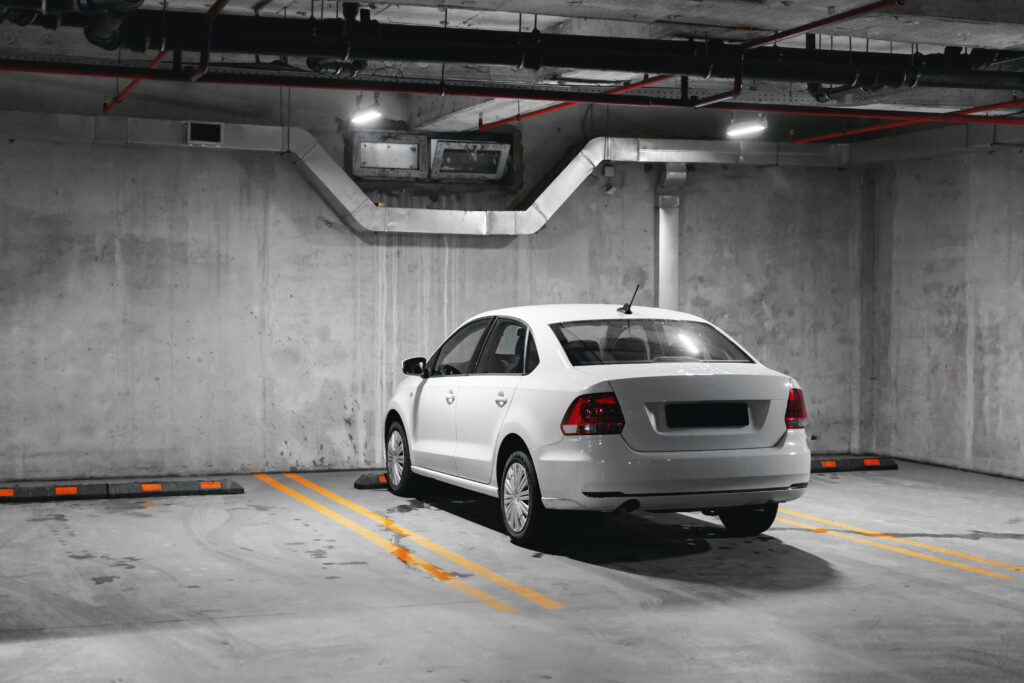
Car parking is one of the most under-thought parts of a residential build. Families spend months agonising over kitchen layouts and bathroom finishes, then end up with a parking bay that scratches the doors of their own SUV every time they turn into it. In urban India — where land is scarce, cars keep getting bigger, and a poorly planned parking space causes daily friction with neighbours — getting the parking dimensions right at the design stage matters as much as any other room in the house.
This article covers the standard car parking sizes specified by the National Building Code of India (NBC) 2016, the practical dimensions our architects use on residential projects, and the design mistakes we see most often when families try to squeeze parking into a tight plot.
Quick answer: As per NBC 2016, the minimum individual car parking size is 3.0 m × 6.0 m (≈10 ft × 20 ft), and the minimum common parking size is 2.5 m × 5.0 m (≈8.2 ft × 16.4 ft). For independent residential homes in Delhi NCR, we typically recommend planning to 8.5 ft × 16.5 ft per car as a working minimum, with 9 ft × 18 ft for SUVs and larger vehicles.
Why Car Parking Standards Matter in India
India’s car ownership has roughly tripled over the last two decades, and most of that growth has happened in cities where building plots have stayed the same size. Parking demand has gone up; the land hasn’t. The result is what every Indian homeowner already knows: cars parked half on the road, neighbours arguing over a shared driveway, scratched doors, and the daily five-minute negotiation of getting a sedan into a slot designed for a hatchback.
The NBC 2016, along with state-level Development Control Rules and municipal byelaws, sets minimum dimensions for parking specifically to prevent these problems. For a builder or house construction company, following these standards isn’t optional — it’s required for plan sanction, and it directly affects whether the home is genuinely usable on day one or whether the family will be tearing out the boundary wall in year two to make room.
A well-planned parking area also adds measurable resale value. In our Delhi NCR market, we have seen identical homes price differently in the resale market based purely on whether the parking accommodates one car or two, and whether it can take an SUV or only a sedan.
Standard Car Parking Size in India (as per NBC 2016)
The NBC 2016 specifies two minimum parking dimensions depending on the parking arrangement:
| Parking Type | Minimum Dimensions (Metric) | Approximate (Imperial) |
|---|---|---|
| Individual / single-bay parking | 3.0 m × 6.0 m | ~10 ft × 20 ft |
| Common / shared parking (apartments, complexes) | 2.5 m × 5.0 m | ~8.2 ft × 16.4 ft |
Some states — Maharashtra is the most-cited example — permit a reduced size of 2.3 m × 4.5 m (≈7.5 ft × 14.7 ft) for up to 50% of parking slots in larger projects, intended for compact cars. State and municipal byelaws ultimately govern what is permitted on your specific plot, so always confirm against your local development authority before finalising drawings.
For practical residential planning, our architects work with three vehicle-size tiers that map onto the homes we deliver in Delhi NCR:
- Compact car (hatchback like Swift, i20, Baleno) Working minimum: 7.5 ft × 15 ft (≈2.3 m × 4.5 m) This is the lower end of what is comfortable. Anything tighter and door-opening becomes a daily problem, especially with passengers on both sides.
- Standard car (sedan or compact SUV like City, Verna, Creta, Brezza) Working minimum: 8.5 ft × 16.5 ft (≈2.6 m × 5.0 m) This is what we recommend as the default for residential bays. Enough room for full door opening on at least one side, modest manoeuvring clearance, and room for a small cabinet or shoe rack along one wall if needed.
- SUV or large vehicle (Fortuner, Innova, XUV700, Safari, full-size MUVs) Working minimum: 9 ft × 18 ft (≈2.7 m × 5.5 m) Needed for full door swing, boot access, and the wider turning arcs that taller vehicles demand. If you currently drive a sedan but anticipate upgrading to an SUV, build to this dimension now — adding a foot of width or two feet of length later is structurally expensive.
These working minimums sit at or above the NBC requirements. Where NBC says the legal floor, our experience says these are the liveable floors — the dimensions where the family actually uses the parking comfortably for ten years rather than learning to live with it.
Home Car Parking Size in Feet (Independent Houses)
For independent houses on plots of 100–500 sq yards, parking planning is a balance between meeting NBC requirements, keeping the front setback usable, and leaving enough room for the family’s actual vehicle inventory — present and future.
A few practical rules our project team applies on residential builds:
- Driveway width: minimum 10 ft. Anything narrower makes turning into the bay difficult, especially for the second driver in the family who hasn’t memorised the exact angle yet. For double-car driveways, plan 16–18 ft minimum.
- Clearance between two parked cars: at least 2.5 ft (preferably 3 ft). This is door-opening space. If you cannot open both doors fully when the cars are parked, the parking is too tight.
- Covered garage height clearance: minimum 10 ft (preferably 11 ft). This accounts for SUVs with roof rails or carriers, and gives breathing room for any future ceiling-mounted lighting, fans, or storage racks. A 9 ft clearance is the absolute legal floor and we don’t recommend it.
- Plan parking as a multi-purpose space: In most independent houses, the parking ends up doing double duty as a service entrance, a temporary unloading bay during renovations, and overflow storage during festivals. Building 10–15% extra into the planned dimension is almost always worth the cost.
A common request we get from families on smaller plots is “can we shrink the parking by a foot to give the living room another foot?” The honest answer is usually no. A foot lost from parking is a daily inconvenience for the next twenty years; a foot added to a living room is rarely felt at all.
Parking in Apartments and Commercial Projects
For apartment complexes and commercial developments, parking is governed by Floor Area Ratio (FAR) regulations, Equivalent Car Space (ECS) norms, and municipal byelaws that are stricter than residential rules. The general framework looks like this:
- At least one parking space per dwelling unit in residential projects, with state and city variations
- Visitor parking as a percentage of total parking (typically 10–20%)
- Turning radius and aisle width: typically 14–16 ft of aisle width for two-way movement, with adequate turning radius at every corner so that a full-size vehicle can manoeuvre without three-point turns
- Equivalent Car Space (ECS) area: NBC and the Ministry of Housing and Urban Affairs model byelaws use ECS as the unit for parking allocation, with 18 sq m for open parking, 23 sq m for ground-floor covered parking, and 28 sq m for basement parking — figures that include circulation space, not just the parking bay itself
These standards are checked at plan approval stage. Builders cutting corners on aisle width or visitor parking commonly run into rejection cycles that delay sanction by months.
Factors That Influence Car Parking Size
The “right” parking size for a specific home depends on several factors beyond the NBC minimum:
1. Vehicle type and future-proofing: A hatchback today may become a Creta in five years, and the Creta family becomes a Fortuner family ten years later. Plan for the largest vehicle the family is likely to own, not the smallest one they currently own. Re-sizing parking after the structure is built is one of the most expensive renovations we get called for.
2. Door-opening clearance: Modern vehicles have wider doors than older ones. If your parking is in a shared compound wall configuration, account for both your door and the neighbour’s wall. A nominally “8 ft wide” bay with a 6 inch boundary wall pillar 2 ft into the bay is functionally a 6-foot bay.
3. Driveway slope: Plots that sit higher than the road require a sloped driveway to get the car up to the parking level. Steeper slopes require additional length on the parking itself — the front of a low-slung sedan can scrape on the transition between slope and flat, and you need a flat run-up before the parking bay to avoid this. As a rule of thumb, a 1:8 slope is the maximum we use for residential driveways.
4. Boot access and luggage handling: A parking bay that is exactly the length of the car gives no room behind the boot. Real-world parking — groceries, suitcases, school bags — needs at least 1.5–2 ft of free space at the rear of the vehicle.
5. Local byelaws and FAR considerations: In many Indian cities, parking that is fully enclosed counts toward FAR while open or stilt parking does not. This affects how big a house you can build on your plot. For projects in Noida, Greater Noida, Delhi, Gurgaon, and Faridabad, we factor these rules into the design before finalising the parking footprint.
Parking Construction Cost Per Sq Ft
The cost of building a parking area depends mostly on the level of finish and whether the parking is open, covered, or basement. As a working range for residential projects in India:
- Open parking (paved area only): approximately ₹200–400 per sq ft, depending on the paving material — concrete, paver blocks, kota stone, or designer cobblestone
- Covered garage with walls and roof: approximately ₹600–900 per sq ft, depending on roof type, ventilation, and finishes
- Premium finishes: ceramic tiling, designer lighting, automated shutters, EV charging infrastructure — push these numbers higher
Discussing parking specifications at the design stage is significantly cheaper than retrofitting after the structure is built. A wall moved on paper costs nothing; the same wall moved on site after foundation work has begun costs ₹15,000–₹30,000 in demolition and rework, plus the schedule slip.
Parking Design Mistakes to Avoid
These are the five mistakes we see most frequently on residential plots, and the simplest fixes for each:
- Bays that are too narrow: The single most common mistake. A bay that is “wide enough” for the car at standstill is not wide enough to open the doors comfortably. Door dings, scratches on the boundary wall, and daily inconvenience follow. Plan for 8.5 ft minimum width on standard bays, 9 ft on SUV bays.
- lgnoring the turning radius: A bay sized correctly is still unusable if the entrance angle forces a three-point turn every time. The aisle in front of the bay needs to be wide enough — typically 14–16 ft — for the car to turn into the bay in a single movement.
- Sealing covered garages without ventilation: Cars in fully enclosed garages without ventilation create heat buildup, fume accumulation, and condensation on stored items. At minimum, plan for a louvered opening or a vent at the top of one wall. For garages used as utility space, an exhaust fan is worth the small investment.
- No drainage slope: Parking that doesn’t slope toward a drain becomes a small swimming pool every monsoon. The standard fall is 1 in 100 (1 cm per metre) toward a side drain or grating. Without this, water pools, the floor stains, and over years the screed itself starts to break down.
- Forgetting future EV charging: This is the new mistake we now see on every project. Even if you don’t currently own an EV, the chances are high that you or the next owner will. Pulling a 32A power line and a conduit to the parking bay during construction costs almost nothing; retrofitting it later means breaking the floor.
Tips for Homeowners and Builders
A short checklist drawn from what works on our residential projects:
- Verify local byelaws before finalising the design. NBC sets the national floor; your municipal authority may require more. For Delhi NCR specifically, Noida, Greater Noida, Gurgaon, Faridabad, and Ghaziabad each have their own rules layered on top.
- For multiple-car plans, scale in multiples of 8.5 × 16.5 ft, with 2.5 ft door clearance between bays. Don’t cluster cars too tight, and don’t space them so wide that you waste plot area.
- Use durable flooring suited to the use case. Concrete is cheap and tough; paver blocks allow some drainage; kota stone looks better but stains; designer tiles look great but crack under loaded SUV tyres unless they’re rated for vehicular use.
- Plan lighting and security from day one. Conduiting and mount points are far cheaper to install during construction than to retrofit later. At minimum, plan for one LED light per bay, one motion sensor at the entry, and provision for a CCTV camera covering the parking area.
- Show parking layout in plan drawings. For families building to sell or rent, well-documented parking dimensions in the plan add to buyer confidence. In our Delhi NCR market, this is increasingly something serious buyers ask about before they ask about anything else.
Conclusion
A well-planned parking space is not just a convenience — it’s a long-term investment in the comfort, safety, and resale value of the home. Whether you’re a homeowner planning the parking dimensions for your independent house or a builder designing for an apartment complex, complying with NBC 2016 standards and adding the practical buffers we have laid out above ensures the parking is genuinely usable from day one and stays usable as vehicles get larger.
The single most important point: parking dimensions are far cheaper to get right at the design stage than to fix after construction. A few hours with an experienced architect at the planning phase saves years of daily frustration later.
If you are planning a home and want help getting the parking right alongside the rest of the structural and architectural design, contact our team at Walls and Dreams — we can walk you through the NBC requirements, the local byelaws for your specific site, and the practical considerations specific to your family’s vehicle plans. We deliver residential projects across Delhi, Noida, Greater Noida, Gurgaon, Faridabad, and Ghaziabad, and parking is something we get asked about on almost every brief.
Frequently asked questions
What is the standard car parking size in India as per NBC 2016?
As per the National Building Code (NBC) 2016, the minimum individual car parking size is 3.0 m × 6.0 m (approximately 10 ft × 20 ft), and the minimum common parking size is 2.5 m × 5.0 m (approximately 8.2 ft × 16.4 ft). Some states permit a reduced size of 2.3 m × 4.5 m for up to 50% of slots, intended for compact cars.
What is the recommended car parking size in feet for a residential home?
For a standard car or compact SUV, the recommended working minimum is 8.5 ft × 16.5 ft per bay. For larger SUVs and MUVs such as the Fortuner or Innova, plan for 9 ft × 18 ft. For compact hatchbacks, a 7.5 ft × 15 ft bay is the lower end of comfort. These working minimums sit at or above the NBC requirements and reflect what is genuinely usable on residential plots.
What is the parking size for an SUV in India?
For full-size SUVs and MUVs such as the Fortuner, Innova, XUV700, or Safari, the recommended parking size is 9 ft × 18 ft (approximately 2.7 m × 5.5 m). This accommodates full door swing, boot access, and the wider turning arcs that taller vehicles require.
What should be the minimum driveway width for a home?
A minimum driveway width of 10 feet is recommended for single-car access, allowing comfortable turning into the parking bay. For double-car driveways or homes where two cars need to enter and exit independently, plan for at least 16–18 feet of driveway width.
What is the minimum height clearance required for a covered garage?
A minimum height clearance of 10 feet is recommended for covered residential garages, with 11 feet preferred. This accounts for SUVs with roof rails or carriers, and provides breathing room for ceiling-mounted lighting, fans, or storage. A 9-foot clearance is the absolute minimum and is generally not recommended.
What is the cost of parking construction per sq ft in India?
Open parking with paving typically costs ₹200–400 per sq ft depending on the paving material — concrete, paver blocks, kota stone, or designer cobblestone. Covered garages with walls and a roof typically cost ₹600–900 per sq ft. Premium finishes such as ceramic tiling, designer lighting, automated shutters, or EV charging infrastructure push these numbers higher.
What is Equivalent Car Space (ECS) in NBC?
Equivalent Car Space (ECS) is the unit used in NBC and Ministry of Housing and Urban Affairs model byelaws to allocate parking in apartment and commercial projects. The standard ECS area allocations include circulation space: 18 sq m for open parking, 23 sq m for ground-floor covered parking, and 28 sq m for basement parking. These figures cover the parking bay plus the aisle and manoeuvring space required to access it.
What is the minimum turning radius for parking in India?
For apartments and commercial parking, the typical aisle width is 14–16 feet for two-way movement, with adequate turning radius at every corner so that a full-size vehicle can manoeuvre without three-point turns. A bay sized correctly is still unusable if the entrance angle forces multiple turns to enter.
How many parking spaces are required per dwelling unit in apartments?
The general framework is at least one parking space per dwelling unit in residential projects, with state and city variations. Visitor parking is typically required at 10–20% of total parking. Some state byelaws allow 2 ECS per 100 sq m of floor area, which works out to roughly 1 space per 3 BHK and 2 spaces per 4 BHK, but local authorities vary — always verify against the specific municipal byelaw for your project.
This article references the National Building Code of India (NBC) 2016, published by the Bureau of Indian Standards. State-level Development Control Rules and municipal byelaws may impose additional or differing requirements; always verify against your local authority before finalising drawings.
Last reviewed: April 2026 by the Walls and Dreams technical team. Next review: October 2026.